YouTube has changed the meaning of one of its most familiar metrics.
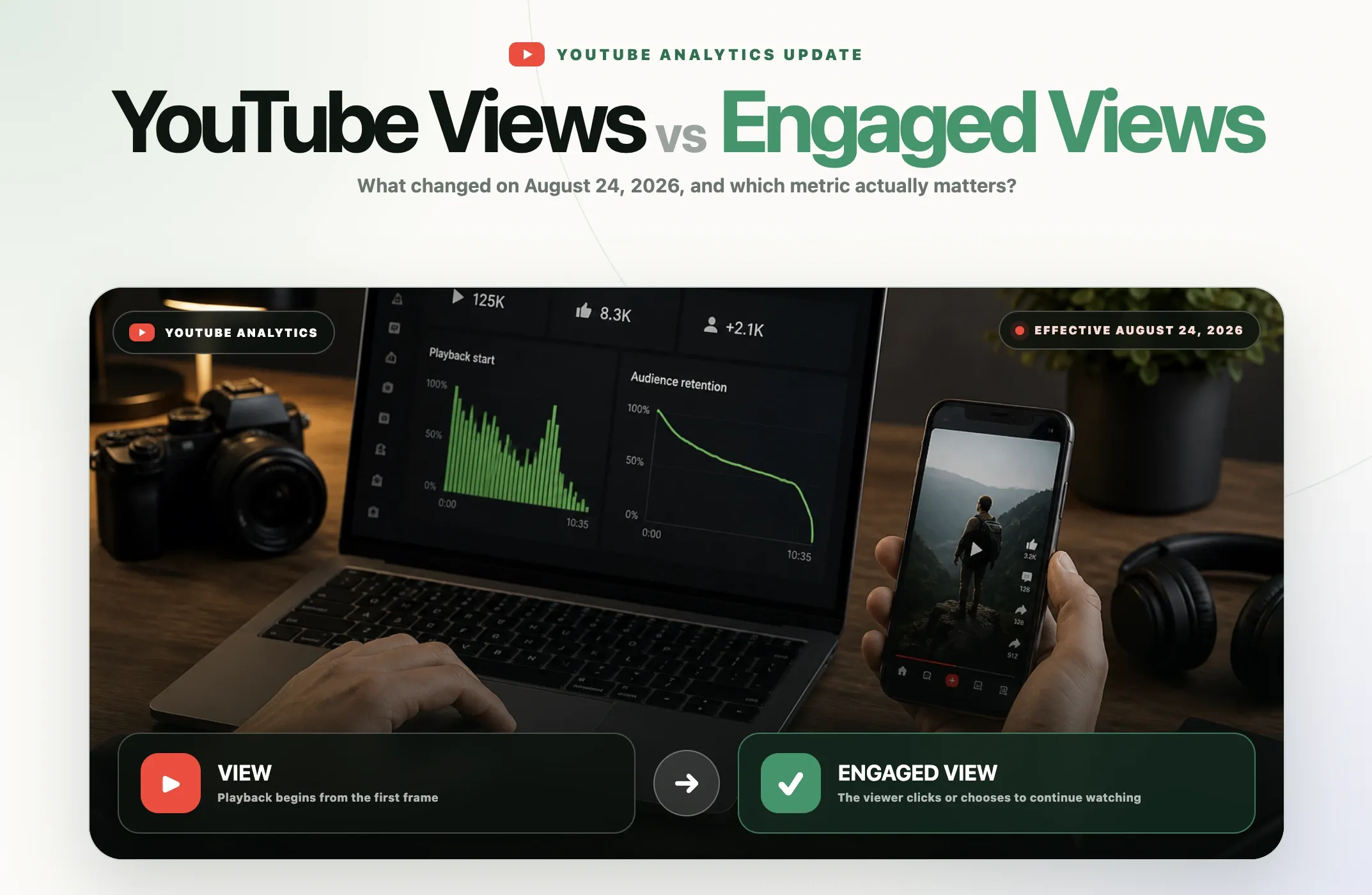
Starting August 24, 2026, a public view is counted from the moment a video begins playing. The rule applies globally to YouTube Shorts, long-form videos, podcasts and livestreams.
The measurement YouTube previously called a view has not disappeared. It is now called an engaged view, and it remains available to creators in YouTube Analytics.
This creates two different numbers for understanding video performance. Public views measure how often playback started. Engaged views measure how often a viewer chose to continue beyond that initial start or deliberately clicked to watch.
Quick answer: A YouTube view now counts from the first frame. An engaged view records a more meaningful choice to continue watching or a click or tap that starts playback. Public view totals may grow faster, but YouTube says monetization, YPP eligibility, recommendations, CTR, average view duration and retention are not changing because they remain tied to engaged or qualified activity.
Important: YouTube does not describe one universal public time threshold that turns every autoplay into an engaged view. Its official explanation says the viewer must continue for some amount of time after the first frame. Avoid repeating a fixed number of seconds unless YouTube documents that number for the specific surface or report being discussed.
What changed in YouTube's view count?
Before this update, YouTube used different public view-counting approaches across different formats. Shorts moved to first-frame counting in 2025, while other formats used a different system.
YouTube says the new definition creates a consistent public exposure metric across the platform:
- A Short begins playing in the Shorts Feed: one public view starts from the first frame.
- A long-form video begins autoplaying on the Home page: one public view starts from the first frame.
- A podcast video begins playing: one public view starts from the first frame.
- A livestream begins playing: one public view starts from the first frame.
The visible number beneath a video can therefore include very brief starts that do not become engaged views. YouTube may still validate, adjust or remove low-quality playback activity to protect metric integrity.
Because the public definition changes on August 24, 2026, creators should treat that date as a measurement break when comparing view totals before and after the update.
YouTube views vs engaged views
|
Metric |
What it measures |
Where it matters |
|---|---|---|
|
Public view |
A video starting to play from its first frame |
Public counters, exposure, cross-format scale and top-level reach reporting |
|
Engaged view |
A viewer continuing beyond the initial start, or clicking or tapping to watch |
YouTube Analytics, attention analysis, monetization calculations and consistent historical comparison |
|
Qualified view |
An eligible public engaged view that satisfies YouTube's YPP rules |
YouTube Partner Program eligibility |
|
Thumbnail impression |
A registered display of a thumbnail on an eligible YouTube surface |
Impressions, click-through rate and packaging analysis |
|
Unique viewer |
YouTube's estimate of the number of different people who watched |
Audience-size estimates and frequency context |
The metrics answer different questions. Public views indicate exposure. Engaged views indicate an initial level of attention. Watch time and retention show how long that attention continued. Conversions reveal whether the video produced the intended result.
None of these numbers should be expected to explain the entire performance of a video alone.
What counts as an engaged view on YouTube?
YouTube defines an engaged view as a viewer watching beyond the initial first frame or clicking to watch.
There are two important paths:
- Deliberate click or tap: If someone clicks or taps a thumbnail and playback begins, YouTube counts both a view and an engaged view.
- Autoplay continuation: If playback begins automatically, it counts as a public view from the first frame. It becomes an engaged view after the viewer continues for some amount of time.
This means an engaged view is not simply another name for a long watch. It marks a stronger initial engagement event than the new first-frame public view. Creators still need watch time, average percentage viewed and retention data to understand the depth of that engagement.
Do thumbnail previews and autoplay count as views?
They can.
If a thumbnail appears on Home, a channel page, the Watch page or another eligible surface and nothing plays, it remains a thumbnail impression. No public view is recorded merely because the image appeared.
If the viewer hovers over the thumbnail and the video starts autoplaying, the first frame now creates a public view. If the viewer lets that preview continue, it may also become an engaged view.
If the viewer clicks or taps the thumbnail to start the video, YouTube counts a view and an engaged view.
This distinction is important when reading top-level view numbers. A video can receive more playback starts without receiving the same increase in deliberate clicks or sustained attention.
Will YouTube view counts increase?
Many creators are likely to see public views accumulate faster after August 24 because the new counter includes playback from the first frame. The amount of change will differ by channel, format, traffic source and viewer behavior.
A creator whose videos receive substantial Home-page preview exposure could see a different gap from a creator whose audience mostly arrives through deliberate Search clicks. Shorts creators may see less of a discontinuity because Shorts already adopted first-frame counting.
A third-party analysis released by creator advertising platform Agentio modeled 35,800 long-form creator videos and estimated that public views could appear approximately 30% higher than engaged views under one assumed threshold. It also found that the modeled difference varied by channel size and category.
That figure is not an official YouTube forecast and should not be applied as a guaranteed increase. It is useful only as evidence that exposure and meaningful attention can diverge materially.
Does the view-count update affect YouTube earnings?
No. YouTube says the public view-count change does not alter creator earnings.
YPP earnings continue to rely on engaged Shorts views and engaged watch hours rather than every first-frame public view. A higher number beneath a video therefore does not automatically create a matching increase in revenue.
Revenue also depends on factors such as eligible monetized playbacks, advertising demand, audience location, subscription viewing, content category and the monetization features enabled on the channel.
The practical rule is simple: do not use a sudden rise in public views to forecast a proportional rise in revenue. Compare earnings with engaged views, engaged watch hours and monetized playback data instead.
Does it change YouTube Partner Program eligibility?
No. YouTube says YPP eligibility remains based on qualified watch hours and qualified Shorts views.
A qualified metric must satisfy YouTube's eligibility conditions. For example, private, unlisted and deleted uploads do not contribute to the relevant thresholds. Paid advertising traffic and automatic Shorts loops are also excluded from qualified totals.
The public view number can therefore be higher than the number that moves a channel toward YPP eligibility.
For the current entry thresholds, Shorts revenue rules and upcoming contract deadline, read Reap's complete guide to the YouTube Partner Program changes for 2027.
Are CTR, average view duration and retention changing?
YouTube says the vast majority of analytics remain anchored on engaged views. The company specifically says the calculation of click-through rate, average view duration and audience retention is not changing because of the new public counter.
Click-through rate
CTR continues to help creators understand how often eligible thumbnail impressions lead to a view through a click. A first-frame autoplay view is not the same event as a thumbnail click.
Average view duration
Average view duration continues to reflect the average watch time associated with engaged viewing. It should not suddenly collapse because first-frame public views entered the visible counter.
Audience retention
Retention still reveals where engaged viewers remained, skipped, rewatched or left. It remains more useful than a public view count for diagnosing the opening, pacing and payoff of a video.
If duration decisions are part of the problem, Reap's guide to the best video length for YouTube Shorts and long-form videos explains how to use average view duration, percentage viewed and retention together.
Does the update affect YouTube recommendations?
YouTube says there is no change to recommendations.
The platform is changing how public exposure is counted, not replacing its recommendation systems with a first-frame metric. Recommendations continue to use a broad collection of viewer and content signals.
Creators should not optimize for accidental starts. A misleading title or thumbnail may produce a start, but it can still lose the viewer immediately and fail to create satisfaction, watch time or a meaningful outcome.
The better response is to align the packaging and opening:
- Make the title and thumbnail promise one clear result.
- Confirm that promise in the opening seconds.
- Remove unrelated introductions and repeated setup.
- Deliver the first useful detail early.
- Keep enough context for the video to remain accurate.
These video editing tips for stronger hooks, pacing and retention can help improve the viewing experience after the first frame.
Where can creators find engaged views?
YouTube says engaged views remain available in YouTube Analytics Advanced Mode.
- Open YouTube Studio.
- Select Analytics.
- Open Advanced Mode or See More.
- Choose the relevant video, format and date range.
- Add or select the Engaged views metric.
- Compare it with views, watch time, retention and the outcome the video was meant to produce.
Interface labels can vary by report, account and rollout stage. If the metric is not visible in a default card, check Advanced Mode and customize the selected metrics.
Creators using third-party dashboards, exports or reporting APIs should also verify which definition of views each tool displays. A report labeled only “views” can become ambiguous after the update.
How to compare performance before and after August 24
Do not compare raw public views across the update as if the measurement remained identical.
Use this process instead:
- Mark the change date. Add August 24, 2026 to reporting notes and dashboards.
- Use engaged views for continuity. This is the closest available metric to the previous view-counting logic.
- Compare similar videos. Match topic, format, duration, traffic source and audience as closely as possible.
- Separate exposure from attention. Report public views and engaged views as different stages of the viewer journey.
- Add depth metrics. Include watch time, average percentage viewed and retention.
- Measure the outcome. Track subscribers, clicks, leads, sales or movement to another video.
For recurring performance reports, avoid silently replacing the old series with the new public view series. Label the definition change so future readers understand why the line may jump.
What the update means for brand deals and sponsorships
The change makes metric definitions more important in creator contracts and campaign reports.
A public view can be useful as an exposure measure. An engaged view is usually more useful when a brand is paying for deliberate attention. Watch time, retention and conversions provide additional evidence that the message was actually consumed.
Before agreeing on pricing or performance guarantees, creators and brands should define:
- Whether “views” means public views or engaged views
- The reporting window
- Whether paid distribution is included
- Which YouTube Studio report is the source of truth
- Whether the campaign is priced on exposure, attention or an action
- How pre-August 24 benchmarks will be adjusted
Creators should not present first-frame views as if every viewer watched the sponsor segment. Brands should not dismiss public views entirely because they still describe distribution. The two numbers answer different campaign questions.
Which YouTube metrics should creators track now?
|
Question |
Best starting metric |
Add this context |
|---|---|---|
|
How often did playback begin? |
Public views |
Traffic source and unique viewers |
|
How often did viewers choose to continue? |
Engaged views |
Engaged-view rate and opening retention |
|
How long did attention last? |
Watch time and average view duration |
Average percentage viewed and retention curve |
|
Did the packaging earn a click? |
Impressions click-through rate |
Traffic source, title and thumbnail version |
|
Did the video build the audience? |
Subscribers and returning viewers |
Topic, format and publishing consistency |
|
Did the video create business value? |
Clicks, leads, sales or campaign conversions |
Offer, attribution window and audience fit |
|
Does the channel qualify for YPP? |
Qualified views or qualified watch hours |
Current eligibility window and policy compliance |
The public counter is useful, but it should sit at the beginning of the analysis rather than the end.
How creators should adapt their video strategy
Keep the first frame visually intentional
The first frame now creates the public view, but the next moments determine whether that exposure becomes meaningful attention. Avoid blank frames, delayed camera movement and introductions that provide no context.
Make clips stand alone
A short clip needs a clear subject, enough context and a complete payoff. Random excerpts can produce starts without producing engaged viewing.
Reap's guide to repurposing original video without creating low-value reposts explains how to add a new hook, preserve meaning and adapt the next step for each platform.
Use search and metadata to attract intentional viewers
A viewer who actively chooses a relevant answer can behave differently from someone who receives an autoplay preview. State the topic clearly in the video, title and captions.
The guide to short-form video SEO explains how to align a specific question, spoken content, captions and metadata without treating keywords as a substitute for usefulness.
Review the gap between views and engaged views
The gap can become a diagnostic signal. A large gap may indicate substantial preview exposure, weak early continuation or a traffic mix dominated by autoplay surfaces. It does not prove a problem by itself.
Compare the gap across similar videos and traffic sources. Then inspect the opening retention and average view duration before changing the edit.
How Reap fits into an attention-first workflow
The new metric definition reinforces a simple principle: producing more starts is not enough. Each clip still needs to earn continued attention.
Reap's AI video clipping tool can turn long podcasts, interviews, webinars, tutorials and YouTube videos into candidate clips built around complete moments. Creators can review the transcript, adjust the cut, add captions, reframe for vertical video and export multiple versions.
A practical workflow is:
- Choose a source video containing useful answers, examples or stories.
- Find moments that can make sense outside the full recording.
- Begin each clip at the first sentence required for context.
- Use accurate captions and a readable crop.
- End after the payoff rather than cutting mid-thought.
- Publish and compare public views, engaged views, watch time and meaningful outcomes.
Automation can speed up production, but the creator still needs to review meaning, originality, rights and the final edit. The goal is to turn exposure into attention, not to manufacture a larger public counter.
Common mistakes to avoid
Treating every public view as a person who watched
A public view now confirms a playback start. It does not confirm that the viewer watched the complete video or even continued beyond the opening.
Assuming higher views mean higher revenue
YouTube earnings remain tied to engaged activity and monetization conditions. Public views can rise without revenue increasing at the same rate.
Comparing old and new public counts without a note
The definition changed on August 24. Use engaged views for more consistent historical comparisons and label the measurement break.
Calling an impression a view
A thumbnail display remains an impression until playback starts. A hover that triggers autoplay can create a view, while a static thumbnail display does not.
Optimizing only for the first frame
The first frame can start the counter, but continued attention, satisfaction and outcomes still matter. Make the opening useful rather than merely loud.
Using “views” in contracts without defining it
Brand agreements should specify public views or engaged views, the reporting source and the campaign window.
YouTube views and engaged views checklist
- Mark August 24, 2026 as the public view-definition change.
- Use public views to understand playback exposure.
- Use engaged views to understand initial meaningful attention.
- Use watch time and retention to understand depth.
- Use qualified metrics for YPP eligibility.
- Do not forecast revenue from the public view increase alone.
- Check engaged views in YouTube Analytics Advanced Mode.
- Verify which metric third-party dashboards call “views.”
- Define the metric in sponsorship reports and contracts.
- Compare similar videos and traffic sources.
- Keep the first frame clear and the opening worth continuing.
Views measure starts. Engaged views measure a choice.
YouTube's new public view metric gives creators a broader measure of exposure across every major format. That can make the visible scale of a channel easier to compare with short-form platforms that already count from the start of playback.
The tradeoff is that the public counter now says less about meaningful attention by itself.
Creators should use public views to understand distribution, engaged views to understand continuation, retention to understand depth and conversions to understand impact. The metric changed, but the work did not: make an honest promise, confirm it quickly and deliver enough value for the viewer to stay.