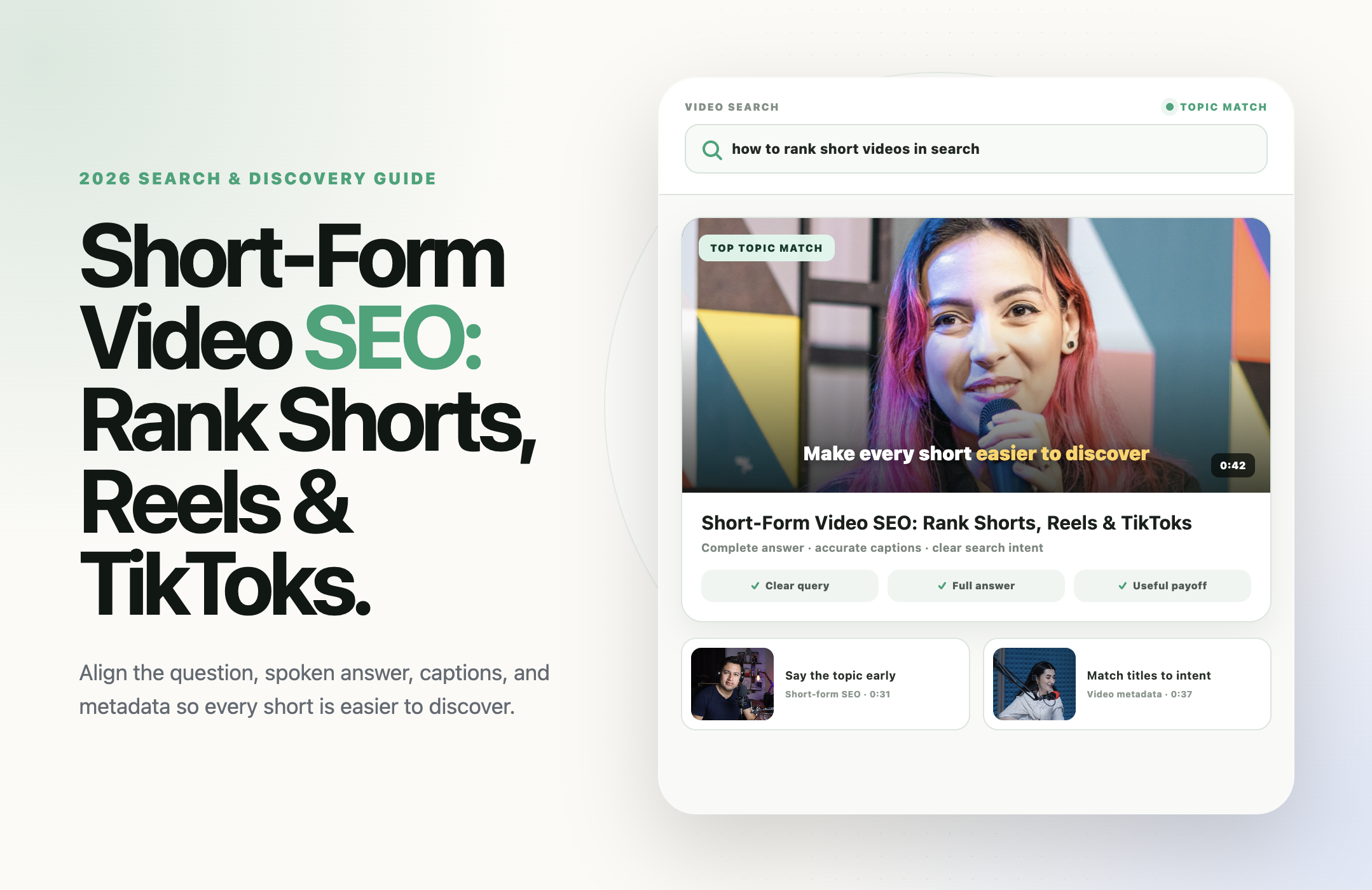
Short videos are no longer discovered only by scrolling.
People search YouTube and TikTok for product advice, tutorials, explanations, reviews, comparisons and answers to specific questions. A useful 45-second clip can now behave like a search result: it meets a need, earns attention and leads the viewer toward a deeper video, product or next step.
YouTube is moving further in this direction. In May 2026, it announced Ask YouTube, a conversational search experience designed for more complex questions and follow-up queries. YouTube’s existing search documentation already says relevance depends partly on how closely the title, description, tags and video content match the query.
TikTok also treats Search as a distinct discovery surface. Its Creator Search Insights tool shows topics people frequently search for, highlights content gaps and provides analytics for posts discovered through Search.
This changes the goal of short-form publishing.
A creator does not simply need a clip that stops the scroll. The clip should also make its topic obvious, answer the viewer’s question and satisfy the reason behind the search.
That is short-form video SEO.
Quick answer: To optimize a short video for search, choose one specific question, answer it clearly in the video, state the subject naturally, add accurate captions and descriptive on-screen text, write metadata that matches the content, and track whether search viewers actually watch. SEO improves relevance and discoverability; it does not guarantee a ranking.
What is short-form video SEO?
Short-form video SEO is the process of making a short video easy for a platform to understand, relevant to a viewer’s search and satisfying enough to watch.
It applies to videos published on YouTube Shorts, TikTok, Instagram Reels and other short-form surfaces where viewers can search for or discover content by topic.
Traditional webpage SEO often begins with a keyword and a page. Short-form video SEO begins with a viewer, a question and a promise.
For example, “webinar marketing” is a broad topic. “How do I turn a webinar into YouTube Shorts?” is a usable search question. A strong short video can answer that question with a focused process, while the title, caption and on-screen text accurately describe the same answer.
Effective video SEO aligns five elements:
- Search intent: what the viewer actually wants to learn, compare, fix or decide.
- Video content: the spoken and visual answer provided by the clip.
- Packaging: the title, cover, description, caption and on-screen setup.
- Viewer response: whether people choose the video, keep watching and find it useful.
- Channel context: the consistency, expertise and audience history surrounding the content.
If the title targets one question but the video discusses something else, the package is misaligned. If the video answers the question but begins with 12 seconds of unrelated setup, search viewers may leave before receiving the answer. If the clip is useful but titled “You need to see this,” the platform and viewer receive little context.
Video SEO is not keyword decoration. It is alignment between the query, the promise and the delivered answer.
Search discovery and feed recommendations are not the same
A video can reach someone because they searched for a topic or because a recommendation system predicted they would enjoy it. These paths overlap, but they are not identical.
A search viewer has expressed intent. Someone who types “best microphone for a two-person podcast” is actively looking for a recommendation. A feed viewer may have shown a general interest in podcasting without asking that specific question.
This affects how the video should begin.
- A feed-first hook might say, “Most podcasters buy the wrong second microphone.”
- A search-first opening might say, “For a two-person podcast, choose two dynamic microphones with cardioid pickup patterns.”
The first creates curiosity. The second immediately confirms relevance. A strong clip can often do both: “Most two-person podcasts need two dynamic cardioid microphones—not one expensive condenser.”
Do not force every video into a search strategy. Reactions, entertainment, cultural moments and personality-driven clips can succeed primarily through recommendations. Tutorials, comparisons, definitions, product questions, troubleshooting and practical advice are especially suited to search.
How YouTube Shorts, TikTok and Instagram Reels discovery differ
The platforms do not publish one shared ranking formula. They also change their systems continuously. The most defensible strategy is to work from what each platform states publicly, then test the creative execution with your audience.
|
Platform |
Published guidance |
Practical implication |
|---|---|---|
|
YouTube Shorts |
YouTube says Search prioritizes relevance, engagement and quality. For Shorts search, it considers factors including metadata match and whether viewers click and watch. |
Align the title and description with the actual answer, make the topic clear inside the video and deliver enough value to hold attention. |
|
TikTok |
TikTok says Search can consider previous behavior, how well content matches the query, hashtags, sounds, language and location. It says content information, including query match, is generally weighted heavily for Search. |
Choose a precise topic, reflect it naturally in the post and use Creator Search Insights to find demand and content gaps. |
|
Instagram Reels |
Instagram distributes eligible Reels through personalized recommendation surfaces such as Reels, Explore and Feed. Meta has disclosed less detailed public guidance about keyword ranking for individual Reels than YouTube and TikTok provide for Search. |
Use clear topic language for viewers, publish original and recommendation-eligible content, and optimize for retention, shares, saves and non-follower discovery without assuming a keyword guarantees reach. |
On YouTube, Search considers relevance, engagement and quality. Its Shorts discovery guidance says search ranking can consider metadata match and whether viewers click and watch. YouTube also says tags are mainly useful for correcting common spelling mistakes and are not essential for discovery.
On TikTok, the platform’s recommendation documentation distinguishes Search from the For You feed. Search results can reflect query match, hashtags, sounds and personalization. Creator Search Insights lets eligible users explore popular searches, content gaps and search performance.
On Instagram, descriptive packaging is still useful because it helps people understand the content. However, creators should not present an unofficial keyword formula as a published Instagram ranking rule. Meta’s public guidance emphasizes recommendation eligibility, originality and audience response across Reels and Explore.
Why short-form video SEO matters more in 2026
Search is becoming more conversational
Viewers increasingly search with complete questions instead of isolated keywords. YouTube’s Ask YouTube announcement reflects that direction: people can ask complex questions and refine their request with follow-ups.
This favors videos that contain a clear, self-contained answer. A vague highlight may be entertaining, but a complete explanation is easier to match to a question and more satisfying after the viewer selects it.
Platforms expose content demand
TikTok’s Creator Search Insights removes some of the guesswork. Creators can see frequently searched topics and filter for content gaps—subjects with search interest but relatively limited video coverage.
Instead of asking, “What should we post today?” a team can ask, “Which question does our audience already have, and which existing recording contains the best answer?”
Short clips can support the full content journey
A searchable Short does not need to replace the long video. It can act as the most specific entry point.
A podcast episode about B2B content strategy might become clips answering:
- How often should a B2B company post on LinkedIn?
- Should a webinar be gated or ungated?
- How do you measure video-assisted pipeline?
- What makes a customer interview useful?
Each question creates a focused discovery asset. Together, the clips build a topic cluster around the full episode.
The anatomy of a searchable short video
|
Element |
Weak execution |
Stronger execution |
|---|---|---|
|
Topic |
“Marketing tips” |
“How to promote a webinar after it ends” |
|
Opening |
“So, yeah, we were talking about this earlier…” |
“After a webinar ends, turn the Q&A into standalone answer clips.” |
|
Context |
The viewer must know the full episode. |
The speaker, problem and outcome are clear inside the clip. |
|
On-screen text |
“Watch this” |
“How to repurpose a webinar Q&A” |
|
Captions |
Names and technical terms are incorrect. |
The transcript is reviewed and important terms are accurate. |
|
Title or post caption |
Stuffed with loosely related keywords. |
Accurately describes the question and outcome. |
|
Payoff |
The clip ends before the answer. |
The viewer receives one complete, usable takeaway. |
|
Next step |
“Link in bio” with no reason. |
“Watch the full webinar workflow for the remaining clip types.” |
The strongest signal is consistency. The same core topic should appear naturally in the question, spoken answer, visual setup and publishing copy. That does not mean repeating an exact keyword five times. It means removing ambiguity.
How to optimize short-form videos for search
1. Begin with a question, not a keyword list
Keywords describe a subject. Questions reveal intent.
“Podcast clips” might mean software, examples, editing techniques, sizes or pricing. “How do I turn a podcast into short clips?” tells you what the viewer needs.
Collect questions from:
- YouTube and TikTok search suggestions
- TikTok Creator Search Insights
- YouTube Studio search terms and audience research
- Comments on your long videos and social posts
- Sales calls, support tickets and community conversations
- Webinar Q&A logs and podcast guest questions
- Queries already bringing people to your website
Prioritize questions that are relevant to your expertise and product. Search demand without business or audience relevance produces empty traffic.
2. Match one video to one search intent
A short video rarely has enough time to satisfy five different intentions.
A clip titled “How to edit podcast clips, add captions, choose music, post on TikTok and make money” promises too much. Split it into distinct answers. Each clip becomes clearer, and the series covers more meaningful searches.
Before editing, complete this sentence:
After watching this clip, the viewer will know how to ________.
If the blank requires “and” several times, the scope is probably too broad.
3. State the subject early and naturally
A search viewer should not need to decode the topic.
Move a clear statement or answer close to the beginning. If the original speaker starts with filler or refers to an earlier discussion, trim the setup or add a concise question card.
Do not force an exact phrase into every sentence. Speak the way a helpful expert would answer a person. Clear language is more valuable than awkward repetition.
4. Make the clip stand on its own
Repurposed clips often fail because they are excerpts rather than complete assets.
Remove phrases such as “as we mentioned earlier” when the earlier context is missing. Identify the person, product or process when necessary. Preserve qualifications that prevent the answer from becoming misleading. End after the payoff, not halfway through the explanation.
For a deeper workflow, see Reap’s guide to repurposing videos without creating low-value reposts.
5. Use on-screen text to confirm relevance
The opening text should help a viewer understand the subject before or as the speaker begins.
Useful formats include:
- “How to turn one webinar into 10 clips”
- “YouTube Shorts SEO: titles vs tags”
- “Why your podcast clips lose context”
- “Best aspect ratio for LinkedIn video”
Keep the text readable and inside platform safe areas. Do not cover the speaker’s face, product interface or captions. The overlay should describe the video, not bait viewers with a promise the answer never fulfills.
6. Add accurate captions
Captions help people follow a video when sound is unavailable or difficult to understand. They also make names, numbers and technical terms visible.
Captions are not a guaranteed ranking switch. Their first job is communication and accessibility. That is valuable on its own, and clearer comprehension can support the viewer behavior that platforms measure.
Review automatically generated text before publishing. Correct brand names, product names, acronyms, statistics and homophones. A beautifully styled caption that changes the meaning of the answer weakens trust.
7. Write metadata for humans first
The title or post caption should accurately describe what the viewer will receive.
On YouTube, use a specific title that matches the content. Add a concise description with necessary context and a related-video path when appropriate. YouTube says tags are not important for most discovery and are mainly useful for misspellings, so do not treat the tag box as the strategy.
On TikTok, write a natural caption that reinforces the topic. Use a small number of genuinely relevant hashtags if they help classify the post or reach a topic community. TikTok says query match, hashtags and sounds can inform Search, but adding a popular hashtag does not make an unrelated video relevant.
On Instagram, use a descriptive caption and cover that tell the audience what the Reel contains. Treat keywords as clarity tools—not a guaranteed formula for Reels reach.
8. Adapt the package for each platform
Cross-posting your original footage is efficient, but every platform presents the video differently.
|
Asset |
YouTube Shorts |
TikTok |
Instagram Reels |
|---|---|---|---|
|
Opening |
Confirm the search promise immediately. |
Combine topic clarity with a native, conversational hook. |
Make the value visually clear for Reels and feed viewers. |
|
Publishing copy |
Specific searchable title and useful description. |
Natural caption tied to the topic and audience language. |
Descriptive caption with a clear save, share or discussion reason. |
|
Next step |
Use a related video when the Short supports deeper YouTube content. |
Point to the profile, series or next video when appropriate. |
Invite a save, share, profile visit or relevant conversation. |
|
Measurement |
Search traffic, search terms, viewed vs swiped away, retention and related-video behavior. |
Search analytics, retention, traffic source and meaningful actions. |
Non-follower reach, watch time, shares, saves and profile actions. |
9. Deliver the answer before the call to action
A viewer searched for help, not a prolonged introduction to your brand.
Give the useful answer first. Then offer a logical next step:
- Watch the full tutorial.
- See the complete comparison.
- Download the checklist.
- Try the workflow.
- Watch the next answer in the series.
The CTA should continue the same intent. A clip about caption accuracy should not abruptly promote an unrelated feature.
10. Measure satisfaction, not only position
Search rankings can change by viewer, location, language, freshness, competition and platform testing. A manual rank check is therefore an incomplete measure.
Track whether the right viewers find and use the video:
- Search impressions or search traffic where available
- Queries associated with the video
- Viewed versus skipped behavior
- Average watch time and completion
- Rewatches, saves and shares
- Comments that reveal whether the answer was understood
- Visits to the full video, profile, website or product
- Leads, sign-ups or assisted conversions connected to the topic
A clip with fewer views but strong search intent may create more product discovery than a broadly viral clip. Match the metric to the job.
A practical example: turn one webinar answer into three searchable clips
Imagine a 45-minute webinar contains a five-minute answer about repurposing event content.
The source section covers three separate questions:
- How many clips can you create from one webinar?
- Which webinar moments make the best short videos?
- How soon should you publish clips after a webinar?
Do not publish the entire five-minute section as one loosely titled clip. Create three standalone answers.
Clip one: output planning
Opening: “A focused 45-minute webinar can often produce clips from the opening promise, each major lesson, the product demonstration and the strongest Q&A answers.”
On-screen text: “How many clips can one webinar create?”
YouTube title: “How Many Shorts Can You Make From One Webinar?”
Clip two: moment selection
Opening: “The best webinar clips are complete answers, surprising insights and demonstrations with a visible outcome—not random excerpts.”
On-screen text: “Best webinar moments to repurpose”
TikTok caption: “Start with complete answers and visible outcomes when turning webinars into short videos.”
Clip three: publishing sequence
Opening: “Publish the first event clip while the topic is still timely, then schedule evergreen answers across the following weeks.”
On-screen text: “When should webinar clips be published?”
Reels caption: “Your webinar should keep working after the live event. Start with the timely recap, then publish evergreen answers.”
The ideas come from one recording. The search intent, opening and publishing package make each asset distinct.
For more examples, read the complete guide to turning a webinar into 10 or more short clips.
How to create search-focused clips with Reap
Reap can accelerate the production work between a long recording and a set of focused short videos. The strategy still begins with the audience question.
Step 1: Upload a source with useful answers
Start with a podcast, webinar, interview, tutorial, presentation, course lesson, product demonstration or other dialogue-rich video you created or are authorized to use.
A clean source gives you more context and quality than downloading a compressed social post. If the recording contains customer information, licensed assets, music or guest contributions, confirm the planned usage first.
Step 2: Guide clip discovery toward search topics
In Reap’s clipping workflow, Clip Topics can guide the analysis toward particular subjects, people or talking points. Use the audience questions collected during research as your direction.
For example, instead of asking only for “marketing clips,” use topics such as “webinar follow-up,” “webinar Q&A clips” and “measuring webinar ROI.”
Step 3: Review candidates for completeness
AI-generated candidates are drafts, not automatic approvals.
Choose moments that:
- answer one recognizable question,
- make sense without the source video,
- begin with enough context,
- preserve qualifications and intended meaning, and
- end after a useful payoff.
Step 4: Refine the answer in the transcript
Reap’s editor supports transcript-based adjustments, including setting new start and end points, removing sections and correcting words.
Trim filler before the answer, but do not cut away context that makes a claim accurate. Correct the transcript before styling the captions. Add a concise text overlay when the spoken opening needs a clearer setup.
Step 5: Format the clip for its destination
Choose portrait 9:16 for Shorts, TikTok and Reels. Reap’s auto-reframing workflow can adapt landscape footage while keeping important speakers and visuals in frame. Always preview the result, especially when the source includes slides, screen shares or more than one speaker.
Keep opening text and captions away from interface elements. Make sure the visual example remains legible on a phone.
Step 6: Export clean platform versions
Create a clean master, then prepare the title, description, caption and CTA for each destination. Do not download one platform’s compressed post and use it as the master for the next upload.
The footage can remain consistent while the package changes to match the audience and discovery surface.
Common short-form video SEO mistakes
- Targeting a broad topic instead of a specific intent. “AI video” is not a clear promise. “How to turn a webinar into Shorts with AI” is easier to answer.
- Writing the title after making a random clip. Decide the viewer’s question before approving the edit.
- Using a searchable title for an unrelated video. Misalignment may earn an initial click but lose trust and watch time.
- Delaying the answer. Search viewers want confirmation that they selected the right result.
- Publishing an incomplete excerpt. A speaker saying “that is why it works” means little when the earlier explanation is missing.
- Stuffing captions or descriptions with repeated keywords. Repetition does not create usefulness and can make the copy difficult to read.
- Overvaluing tags and hashtags. They can provide context, but they cannot repair weak topic match or poor viewer response.
- Leaving transcription errors uncorrected. Incorrect names, numbers and terminology undermine clarity.
- Using one CTA everywhere. The best next step depends on the platform and the viewer’s intent.
- Measuring views without intent. High reach can be commercially irrelevant if the video attracts the wrong audience.
- Assuming SEO guarantees distribution. Search and recommendations are competitive, personalized systems influenced by more than optimization.
A 30-minute search-first repurposing workflow
When the long recording already exists, a focused team can use this operating sequence:
- Five minutes: choose three specific audience questions from search suggestions, Creator Search Insights, comments or sales conversations.
- Five minutes: locate the sections of the recording that answer those questions.
- Five minutes: generate or select clip candidates and reject fragments that require missing context.
- Ten minutes: refine openings and endings, correct captions, add question-led text and check framing.
- Five minutes: write accurate platform-specific titles, descriptions, captions and next steps.
The exact time depends on source length and editorial complexity. The important change is conceptual: the workflow produces answers, not merely files.
Short-form video SEO checklist
Before publishing, confirm:
- The video targets one recognizable search question.
- The question is relevant to our actual audience and expertise.
- The title or caption accurately describes the video.
- The subject becomes clear in the opening seconds.
- The speaker provides a complete answer or useful next step.
- The clip makes sense without the full recording.
- On-screen text is descriptive, readable and inside safe areas.
- Captions are accurate, synchronized and easy to read.
- Names, claims, numbers and technical terms have been checked.
- Hashtags and tags are relevant rather than excessive.
- The CTA continues the viewer’s current intent.
- The export is clean and formatted for the destination.
- The measurement plan includes search and retention signals.
If the video passes the checklist but does not perform, do not immediately add more keywords. Compare the topic demand, opening, answer quality, competition, packaging and audience fit.
The bottom line
Short-form video SEO is not about tricking an algorithm.
It is about making a useful answer easy to recognize.
Start with a real question. Choose a source moment that answers it. Make the clip complete. State the topic clearly. Add accurate captions and descriptive packaging. Adapt the version for each platform. Then measure whether search viewers watch and take the intended next step.
Your long videos may already contain dozens of searchable answers. The opportunity is to find them, shape them and publish them with purpose.
Use Reap to turn podcasts, webinars, interviews, tutorials and product videos into focused short clips with captions, reframing and detailed editing controls.