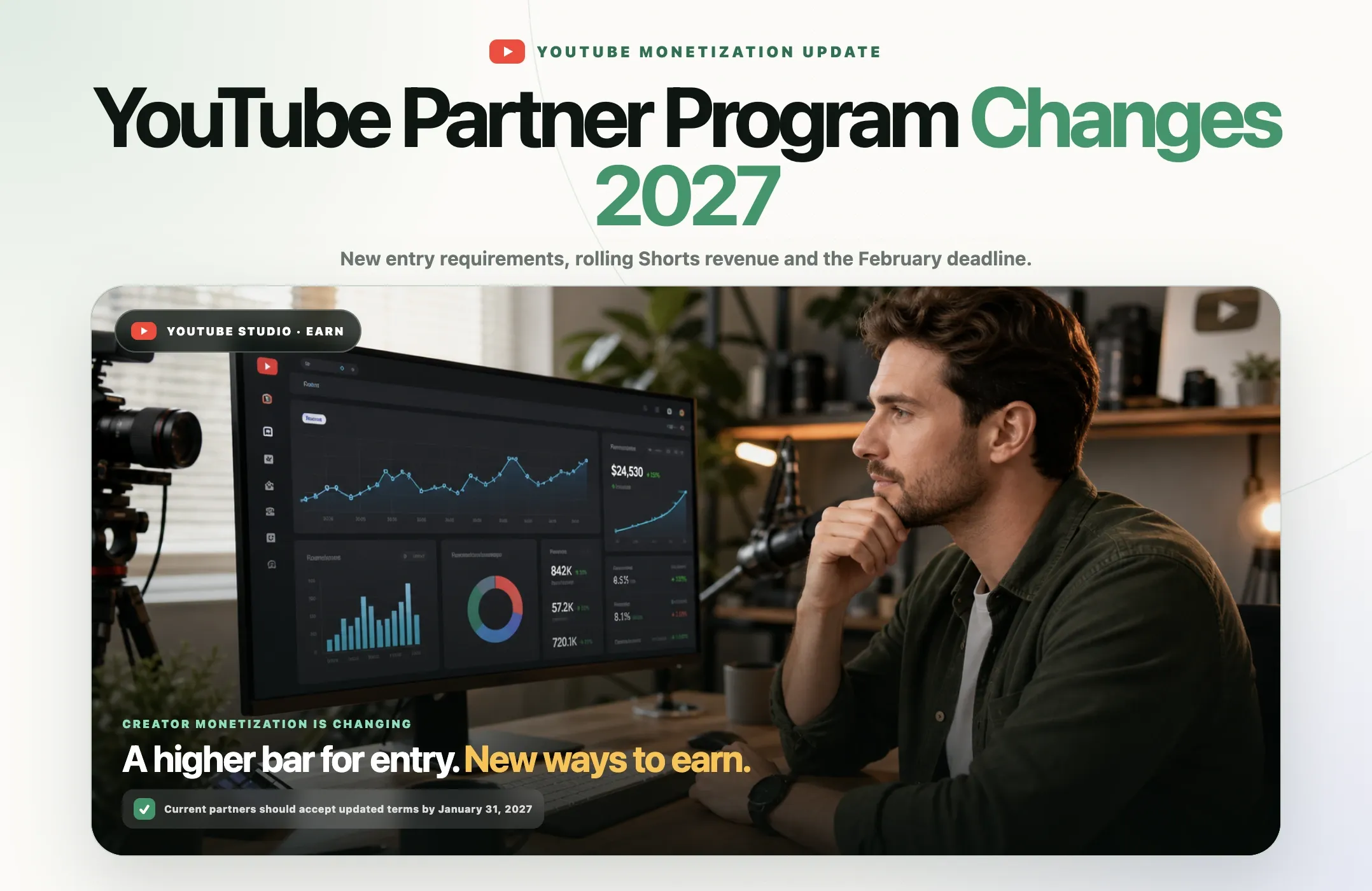
YouTube has announced its biggest Partner Program changes since 2018.
The headline is easy to summarize: new creators will need twice as many watch hours or Shorts views to unlock ads and YouTube Premium revenue sharing. The complete update is more complicated. It changes Shorts payouts for existing partners, expands Premium Lite revenue, introduces activity standards, preserves lower thresholds for fan funding and adds a contract deadline.
The changes were announced on August 10, 2026 and take effect on February 1, 2027. That gives creators time to understand which rules apply to them before changing their publishing strategy.
Quick answer: From February 1, 2027, a new applicant needs 1,000 subscribers and either 8,000 qualified public watch hours in the previous 365 days or 20 million qualified Shorts views in the previous 90 days to unlock ads and Premium revenue. Existing partners keep their YPP status, but Shorts ad and Premium revenue will require 10 million qualified Shorts views in a rolling 90-day period. Current partners should accept the relevant updated terms by January 31, 2027.
Important: This article reflects YouTube's published information as of August 20, 2026. YouTube has not yet released the complete eligibility rules, payment amounts or rollout details for every new Shopping, brand-deal and trend incentive.
YouTube Partner Program changes at a glance
|
Area |
Before February 1, 2027 |
Starting February 1, 2027 |
|---|---|---|
|
New YPP applicant, ads and Premium |
1,000 subscribers plus 4,000 valid public watch hours in 12 months, or 10 million valid public Shorts views in 90 days |
1,000 subscribers plus 8,000 qualified watch hours in 365 days, or 20 million qualified Shorts views in 90 days |
|
Existing YPP partner |
Remains in YPP while following monetization policies and applicable activity rules |
Not required to requalify under the new 8,000-hour or 20-million-view entry thresholds |
|
Shorts ad and Premium revenue |
Available to eligible partners under the current Shorts Monetization Module |
Requires 10 million qualified Shorts views in the rolling previous 90 days for each earning month |
|
Early fan funding and Shopping access |
500 subscribers, three public uploads in 90 days and either 3,000 watch hours or 3 million Shorts views |
Core eligibility thresholds remain unchanged |
|
Premium Lite |
Available in selected markets |
Expands to every country where YouTube Premium is offered |
|
Updated terms |
Current monetization modules remain active |
Relevant updated modules should be accepted by January 31, 2027 to avoid earnings interruption |
1. New YPP applicants face higher ad-revenue thresholds
The most visible change applies to creators who have not joined the full ad and YouTube Premium revenue-sharing tier before February 1, 2027.
A new applicant will still need 1,000 subscribers. In addition, the channel must achieve one of these two paths:
- Long-form path: 8,000 qualified watch hours in the previous 365 days
- Shorts path: 20 million qualified Shorts views in the previous 90 days
Those figures double the current full-monetization requirements of 4,000 watch hours or 10 million Shorts views.
Does every current YouTube creator need 8,000 watch hours?
No. The higher entry thresholds apply to new applicants for ads and Premium revenue sharing. YouTube explicitly says that creators already in YPP will not lose their status or their ability to monetize eligible long-form content merely because they are below 8,000 hours or 20 million Shorts views.
This is the most important distinction in the announcement. A new entry requirement is not the same as a requirement for every current partner to requalify.
The lower YPP entry tier remains
YouTube's expanded YPP gives eligible creators earlier access to fan funding, selected Shopping features and Creator Partnerships. YouTube says those thresholds are not changing:
- 500 subscribers
- Three valid public uploads in the previous 90 days
- Either 3,000 qualified watch hours in the previous 365 days or 3 million qualified Shorts views in the previous 90 days
That tier can unlock features such as channel memberships, Super Chat, Super Thanks and selected Shopping opportunities in eligible markets. It does not automatically unlock Watch Page ads, Shorts Feed ads or YouTube Premium revenue sharing.
2. YouTube is redefining qualified watch hours and Shorts views
YouTube is replacing the phrase valid public with qualified when describing monetization thresholds. This is not simply a label change. Creators need to understand which traffic actually contributes toward eligibility.
What counts as a qualified watch hour?
Qualified watch hours come from public long-form videos, public podcasts and archived public livestreams.
The following do not count toward the long-form threshold:
- Private videos
- Unlisted videos
- Deleted videos
- Watch time generated through advertising campaigns
- Watch hours from the Shorts Feed
- Livestreams that are not archived as public video on demand
What counts as a qualified Shorts view?
A qualified Shorts view must come from a public Short and count as an engaged view. YouTube defines this as a viewer staying beyond the opening seconds. Automatic loops are not added as new engaged views.
Private, unlisted and deleted Shorts do not count. Views purchased through advertising campaigns, long-form views and image posts shown inside the Shorts Feed also do not count.
This matters because a public view count and a qualified monetization count may not match. Use the Earn tab and YouTube Analytics rather than estimating eligibility from the number displayed beneath a video.
3. Shorts revenue sharing gets a rolling 10-million-view requirement
The Shorts change is separate from the new 20-million-view entry threshold.
Beginning February 1, 2027, a creator must maintain 10 million qualified Shorts views over the previous 90 days to receive ads and YouTube Premium revenue from the Shorts Creator Pool for that earning month.
This rule can affect existing partners. A creator can remain in YPP but temporarily stop receiving Shorts Creator Pool revenue when the channel falls below the rolling threshold.
What happens below 10 million Shorts views?
The channel remains in YPP. Eligible long-form ad revenue continues. Fan funding, Shopping and other available YPP income streams can also continue. Shorts revenue sharing automatically resumes after the channel crosses 10 million qualified Shorts views in the previous 90 days again.
YouTube says creators who already earn significant Shorts revenue are unlikely to see a major change. That statement should not be interpreted as a guarantee for every channel because the result depends on whether the rolling view threshold is maintained.
New incentives are planned, but details are incomplete
YouTube says it will introduce targeted earning programs for Shorts creators, including:
- Bonuses connected to YouTube Shopping
- Incentives or production support for brand deals
- Earnings boosts for starting or growing cultural trends
The announcement does not yet provide complete qualification rules, participating markets, payment amounts or application steps. Treat these programs as announced opportunities, not dependable income in a 2027 forecast.
4. Premium Lite creates another subscription-revenue pool
YouTube plans to expand Premium Lite to every country where YouTube Premium is available. Premium Lite provides an ad-free experience for most content and adds offline and background playback.
Creators will participate through separate subscription pools:
- 30% of net YouTube Premium subscription revenue goes into the Premium creator pool.
- 60% of net Premium Lite subscription revenue goes into the Premium Lite creator pool.
- Each pool is distributed according to member watch time and views.
- Creators then receive the standard revenue share of 55% for long-form and 45% for Shorts from their allocated amount.
The 60% figure is not a direct 60% payout to an individual creator. It describes how much Premium Lite net subscription revenue enters the dedicated pool before audience consumption and the standard creator share are applied.
YouTube says that, based on 2026 performance, partners earn more on average from a Premium subscriber than when the same person watches ads. That is a platform-wide average, not an RPM promise for every channel or country.
5. YouTube is adding clearer channel activity requirements
Starting February 1, 2027, YouTube will consider a YPP channel active when it meets at least one of these conditions:
- 1,000 qualified watch hours in the previous 365 days
- 1 million qualified Shorts views in the previous 90 days
- Two long-form videos or five Shorts uploaded every 90 days
Most working channels will satisfy at least one option without changing their schedule. The publication route also means a channel can remain active by consistently uploading even before reaching the view or watch-hour activity measures.
If YouTube considers a channel inactive, the creator gets an additional 90-day window to restore activity. The Help Center says the restoration targets are 1,000 qualified watch hours in 365 days or 1 million qualified Shorts views in 90 days.
Do not confuse these lower activity standards with the much higher thresholds for entering full ads and Premium revenue sharing. They answer different questions.
6. Current partners have a January 31, 2027 terms deadline
Creators already in YPP should review YouTube Studio before the deadline.
YouTube says creators can accept some or all of the updated monetization modules. These may include:
- Watch Page Monetization Module
- Shorts Monetization Module
- Commerce Product Module, where applicable
If a creator does not accept a relevant updated module by January 31, earnings from the associated feature stop on February 1, 2027. Accepting the module later can restore access. Failing to accept is not described as an automatic removal from YPP.
Creators who enabled fan funding before 2023 may still use the older Commerce Product Addendum. YouTube is moving those creators to the current Commerce Product Module. It says the transition does not change fan-funding eligibility, product operation or revenue share.
Who is affected by each YouTube monetization change?
|
Creator situation |
Main effect |
Recommended action |
|---|---|---|
|
Not yet in YPP and pursuing long-form ads |
New 8,000-hour threshold applies from February 1, 2027 |
Track qualified public watch hours and apply before the deadline only if genuinely eligible |
|
Not yet in YPP and pursuing Shorts ads |
New 20-million-view entry threshold applies |
Measure engaged qualified views, not total plays or loops |
|
Already in YPP with long-form revenue |
No requalification under the doubled entry threshold |
Accept updated terms and maintain channel activity |
|
Already earning from Shorts but below 10 million in 90 days |
Shorts pool revenue pauses while below the rolling requirement |
Keep long-form and other revenue streams active while testing a sustainable Shorts plan |
|
In the early YPP tier |
Fan funding and selected Shopping thresholds remain unchanged |
Build community and qualified watch behavior while working toward full monetization |
|
Inactive or seasonal channel |
New activity measures and a restoration window apply |
Plan a small, realistic publishing cadence before the channel becomes inactive |
Why creators are concerned about the update
The announcement produced immediate confusion in creator communities. Some people assumed every current partner would suddenly need 8,000 watch hours. Others focused on the rolling Shorts requirement because it can interrupt Shorts pool revenue even when a channel remains inside YPP.
The concern for new creators is understandable. Doubling the full ad-revenue threshold increases the distance between launching a channel and earning from ads. Shorts-focused channels also face a particularly demanding entry number.
Community reactions are useful for identifying questions, but they are not a policy source. The official announcement and Help Center should control decisions about eligibility, revenue and contract terms.
What creators should do before February 2027
1. Check which YPP tier and modules you already have
Open YouTube Studio and review the Earn tab. Record whether the channel has early fan-funding access, Watch Page ads, Shorts Feed revenue sharing, Shopping or Creator Partnerships.
The right strategy depends on the starting position. An established long-form partner does not need the same plan as a new Shorts-only channel.
2. Track qualified metrics, not headline totals
Separate qualified long-form hours from Shorts engaged views. Do not count paid campaigns, unlisted test videos or loops toward an eligibility target.
Use the rolling windows YouTube uses: 365 days for long-form watch hours and 90 days for Shorts views. A lifetime total cannot reveal whether a channel currently qualifies.
3. Build a mixed-format channel when the subject supports it
Long-form videos and Shorts can serve different roles. A detailed tutorial, interview or podcast can build qualified watch hours and trust. Shorts can attract discovery, test topics and direct interested viewers toward deeper content.
The formats should support one audience rather than feeling like separate channels forced together. Reap's guide to the best length for YouTube Shorts and long-form video can help match duration to the job each upload needs to do.
4. Turn existing long videos into complete Shorts
A useful long-form library may already contain definitions, examples, demonstrations, opinions and answers that can stand alone as Shorts. Clip complete moments instead of uploading random excerpts.
Start at the first necessary sentence, preserve enough context and end after the payoff. For a repeatable system, see how to automate YouTube Shorts creation without removing editorial review.
5. Protect originality and monetization quality
Publishing more is not useful when the output looks repetitive, mass-produced or detached from the creator's own contribution. YouTube eligibility thresholds do not replace its channel monetization policies or review process.
If content is being adapted from podcasts, webinars or interviews, use the framework for repurposing videos without creating low-value reposts. Add a new hook, clear context, purposeful editing and platform-specific packaging.
6. Improve the content before increasing the upload count
More uploads can support channel activity, but a weak video does not become valuable through frequency. Focus on a recognizable topic, a direct opening, clean audio, accurate captions and a complete result.
Use these practical video editing tips for Shorts and YouTube videos to improve pacing and clarity before scaling production.
7. Prepare for revenue beyond ads
The update signals that YouTube wants Shopping, fan funding, brand deals and incentive programs to play a larger role. That does not mean every option fits every channel.
Build the assets those opportunities require:
- A clear audience and content category
- Accurate contact and business information
- A simple media kit
- Consistent publishing and reliable brand safety
- Products or offers that genuinely fit the audience
- Evidence of trust, not only raw view counts
Do not assume future incentive programs will replace predictable revenue. YouTube has not yet published enough detail for that conclusion.
8. Accept the updated terms before the deadline
Set a reminder well before January 31, 2027. Review each module inside YouTube Studio and understand which earning feature it controls. Save confirmation that the relevant terms were accepted.
A practical YouTube content plan for the next five months
|
Period |
Primary work |
What to measure |
|---|---|---|
|
August to September 2026 |
Audit YPP status, qualified metrics, content library and monetization modules |
Current rolling watch hours, Shorts engaged views and revenue by source |
|
October 2026 |
Publish a focused long-form series and cut complete Shorts from the strongest moments |
Watch hours per long video, stayed-to-watch behavior and returning viewers |
|
November 2026 |
Test two or three repeatable Short structures around proven topics |
Qualified Shorts views, average view duration, subscribers and long-form continuation |
|
December 2026 |
Strengthen thumbnails, hooks, captions, playlists and internal video paths |
Click-through rate, retention, end-screen clicks and series-level watch time |
|
January 2027 |
Review eligibility, accept updated modules and document a sustainable publishing plan |
Terms status, activity status and the channel's realistic revenue mix |
Common mistakes to avoid
Buying ads to reach YPP thresholds
Watch time and Shorts views generated through advertising campaigns do not count as qualified metrics. Paid promotion can serve a marketing goal, but it is not a shortcut into YPP.
Assuming Shorts loops equal qualified views
YouTube says qualified Shorts views are engaged views and do not include loops. Optimize the opening for a real decision to continue watching.
Deleting or unlisting videos during a threshold push
Private, unlisted and deleted uploads do not contribute to the relevant qualified totals. Consider the eligibility effect before changing the visibility of videos that produced meaningful watch time.
Thinking existing YPP status guarantees Shorts revenue
Existing status protects a creator from the new entry threshold. It does not remove the rolling 10-million-view requirement for Shorts pool revenue.
Uploading low-value videos only to look active
The activity rule includes a publication option, but YouTube still reviews monetization policy compliance and viewer satisfaction. A sustainable schedule is better than bursts of repetitive uploads.
Budgeting for incentives before the details exist
YouTube has announced new Shopping, brand and trend incentives but has not published complete terms. Do not treat them as guaranteed monthly revenue.
How Reap can support a mixed long-form and Shorts strategy
The new YPP structure makes it useful to think in content systems rather than isolated uploads.
Reap's AI video clipping tool can analyze a long podcast, interview, webinar, tutorial or YouTube video and generate candidate Shorts from complete moments. Creators can guide clipping toward specific topics, choose a duration range, add captions, reframe for vertical video and refine the cut in a text-based editor.
A practical workflow is:
- Publish the complete long-form video when the subject deserves depth.
- Identify complete answers, examples and demonstrations inside the source.
- Create multiple Shorts with distinct hooks rather than repeating the same opening.
- Review every transcript, visual crop, music choice and claim.
- Link relevant Shorts to the longer video when the viewer needs the next level of detail.
- Measure qualified watch behavior and improve the next edit.
Reap can accelerate production, but the creator remains responsible for originality, policy compliance, rights and the publishing decision. The goal is not to manufacture enough low-value posts to chase a threshold. It is to extract more useful content from work that already contains real expertise.
YouTube Partner Program 2027 checklist
- Confirm whether the channel is outside YPP, in the early tier or in full ads and Premium revenue sharing.
- Check the current 365-day qualified watch hours.
- Check the current 90-day qualified Shorts views.
- Do not include ad-campaign views, loops, private videos, unlisted videos or deleted uploads.
- Review whether Shorts revenue is likely to remain above the rolling 10-million-view threshold.
- Plan long-form, Shorts, live and community content around one audience.
- Protect originality and follow all monetization policies.
- Prepare Shopping, brand and fan-funding assets only when they fit the channel.
- Review the Watch Page, Shorts and Commerce modules in YouTube Studio.
- Accept the relevant updated terms by January 31, 2027.
- Check official YouTube documentation again before February because incentive details can change.
The 2027 update changes the path, not the fundamentals
YouTube is raising the full monetization threshold for new applicants and making Shorts pool revenue more demanding. It is also expanding subscription revenue, preserving earlier access to fan funding and Shopping, and promising new incentive programs.
The durable strategy remains the same. Create original videos for a defined audience. Make the promise clear. Deliver enough value to earn real watch time. Use Shorts and long-form for the jobs they perform best. Build revenue sources that do not depend on one threshold or one month of views.
For current partners, the immediate task is administrative: understand the Shorts rule, maintain activity and accept the relevant terms. For new creators, the road to ad revenue becomes longer, which makes audience trust and diversified income more important from the beginning.