
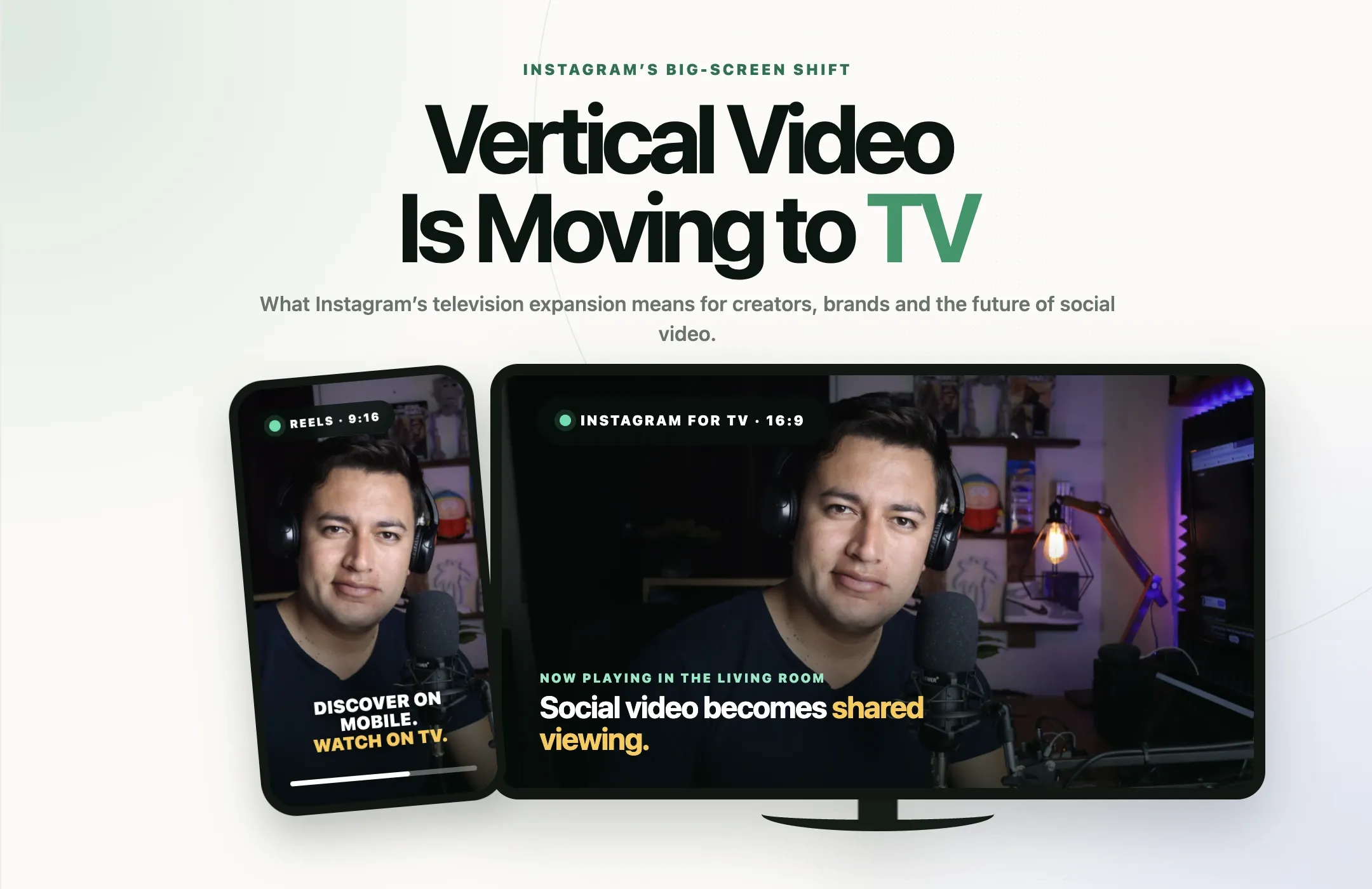
Vertical video was designed around a simple physical behavior: one person holding one phone.
Now that same format is moving into the living room.
Instagram for TV is expanding across connected television devices, and Meta is testing more than a larger version of the Reels feed. The company is exploring interest-based channels, phone casting, Stories, horizontal video, longer creator programs, episodic series and live broadcasts for the television screen.
This is not merely another place to watch Instagram. It is evidence that the boundary between social video and television is becoming less useful. Creators are becoming networks. Social feeds are becoming programming guides. Television is becoming another surface for algorithmic discovery.
The shift also creates a practical question: if a video may be discovered vertically on a phone but watched horizontally on a television, what should creators make?
Quick answer: Keep creating for the phone, but stop treating the phone as the only destination. Preserve flexible framing, larger text, clean audio and high-resolution source footage so one idea can work as a vertical discovery clip, a horizontal television cut or an episodic creator show.
What Instagram announced
Instagram began testing a television experience on Amazon Fire TV in December 2025. It expanded to Google TV devices in the United States in February 2026.
On June 22, 2026, Meta announced that Instagram for TV was expanding to Samsung Smart TVs in the United States, including models from 2020 onward. Meta said that this availability, combined with Fire TV and Google TV, placed Instagram across a majority of connected television devices in the country.
The more important part of the announcement was not device coverage. It was the list of experiences Meta is testing or exploring:
- channels organized around interests such as comedy and sports,
- casting saved Reels from a phone to a television,
- watching Instagram Stories on the big screen,
- a dedicated home for horizontal videos,
- longer-form creator programming,
- episodic series, and
- live creator experiences on television.
Meta describes Instagram for TV as a shared experience where friends and family can watch together, pass the remote and exchange recommendations. That is a very different behavior from silently scrolling alone in a queue.
Why this is bigger than putting Reels on a television
A simple version of Instagram for TV could have been a vertical feed placed in the middle of a wide screen. Meta appears to be testing something more ambitious.
Interest-based channels turn individual posts into programmed viewing. Phone casting connects personal discovery with group watching. Horizontal video acknowledges the geometry of the television. Episodic series invite repeat viewing. Live programming introduces appointment-based experiences.
Together, those pieces resemble a creator-led television system rather than a mirrored mobile app.
YouTube has already demonstrated that creator content can become living-room programming. According to YouTube, viewers watched more than 700 million hours of podcasts on living-room devices in October 2025, up from 400 million hours one year earlier. The format may have originated as audio and grown through mobile discovery, but viewers increasingly treat long creator conversations like television.
Instagram’s expansion suggests that this behavior may extend beyond YouTube. A creator can be discovered through a short clip, followed through a series and eventually watched as part of a longer shared session.
Is horizontal video making a comeback?
Yes, but it is not replacing vertical video.
Vertical video remains the natural shape of the phone. It fills the screen, supports one-handed interaction and fits the swipe-based feeds that drive social discovery. Those advantages do not disappear when a television app launches.
Horizontal video has different strengths. It fits television screens, conversations with multiple people, wide demonstrations, performances, sports, gaming, travel scenes and any composition where the environment matters as much as the speaker.
The most likely outcome is not a winner between 9:16 and 16:9. It is a workflow in which each format performs a different job.
|
Format |
Strongest role |
Typical viewing context |
Creative advantage |
|---|---|---|---|
|
9:16 vertical |
Discovery and fast engagement |
Individual mobile viewing |
Fills the phone and keeps the subject close |
|
1:1 square |
Flexible feed distribution |
Mobile and desktop feeds |
Balances subject, text and surrounding context |
|
16:9 horizontal |
Immersion and sustained viewing |
Television, desktop and group viewing |
Supports environments, multiple people and cinematic composition |
The comeback is therefore not about abandoning vertical shooting. It is about preserving enough visual information to create more than one useful frame.
Why television changes the viewing experience
A Reel does not behave the same way when it moves from a hand to a wall.
The viewer is farther away
Phone text can be small because the screen is close to the face. Television text must survive distance. Thin fonts, dense captions and tiny interface-style labels may become unreadable even when the television itself is large.
The audience may include several people
Mobile recommendations are intensely personal. Television can be communal. A video chosen by one person may be watched by a partner, family or group of friends. Highly niche context can still work, but the video must orient a room quickly.
Sound becomes more important
Social creators often design for muted autoplay. Instagram’s original TV experience was designed to continue playing Reels with full sound. On a television, weak dialogue, uneven volume and harsh background music become more noticeable.
Interaction becomes less direct
A television remote is not a touchscreen. Comments, likes, profile visits and links require more effort. The video itself must carry more of the experience instead of relying on taps and interface behavior.
Sessions can become longer
Mobile feeds encourage repeated micro-decisions to swipe or stay. Television channels encourage a more passive sequence. That can create room for longer stories, but it can also expose weak pacing that a short mobile clip hides.
What creators should change now
Creators do not need to redesign their entire production process for a television app that is still evolving. They should, however, stop locking valuable footage into a single destination.
1. Capture a flexible master
Record at the highest practical resolution and avoid irreversible crops during production. A high-resolution master gives an editor more room to create vertical close-ups and horizontal wide shots later.
2. Protect the center of the frame
Keep the primary subject, product and important action near a shared central safe area. This makes it easier to create 9:16 and 16:9 versions without cutting off faces, hands, demonstrations or text.
3. Leave visual breathing room
Tight mobile framing can become claustrophobic on a large screen. Capture a clean background and enough surrounding space to support wider compositions.
4. Make captions readable from a sofa
Use fewer words per caption, stronger weight, clear contrast and generous spacing. Test the video at a distance rather than judging it only from an editing monitor.
5. Treat audio as a primary layer
Clean dialogue, controlled music and consistent loudness matter more when a video plays through television speakers. Review the final mix on more than headphones.
6. Build repeatable show formats
A television channel needs more than unrelated posts. Recurring interviews, explainers, challenges, reviews and serialized stories give viewers a reason to continue watching and return later.
7. Design an entry point and a full episode
A short vertical clip can introduce a question, character or conflict. A longer horizontal version can deliver the full discussion or story. Planning both from the same idea is more effective than stretching a successful Reel after publication.
8. Keep television rights in mind
Music, footage, sponsorships and creator agreements written for organic social distribution may not always anticipate television or connected-TV use. Brands and agencies should make distribution rights explicit before a campaign travels to additional screens.
A practical multi-screen production model
The safest strategy is to produce one strong source and package it for several contexts.
|
Asset |
Purpose |
Suggested treatment |
|---|---|---|
|
Vertical discovery clip |
Earn attention in Reels and mobile feeds |
Immediate hook, close framing, readable captions and one focused idea |
|
Horizontal television cut |
Support longer or shared viewing |
Wider composition, stronger sound mix, more context and fewer interface-dependent calls to action |
|
Episodic version |
Build returning behavior |
Consistent format, episode identity, recurring structure and a clear next installment |
|
Live version |
Create a scheduled communal event |
Strong host, clear segments, audience participation and television-friendly pacing |
This model lets vertical and horizontal video support each other. The vertical clip is not a damaged version of the program, and the television cut is not a stretched Reel.
Why episodic creator video matters
Meta’s interest in episodic series arrives as vertical microdramas are attracting established entertainment companies. The Associated Press reported in June 2026 that major studios, producers and performers are investing in short serialized dramas, with episodes commonly running one to three minutes.
The important lesson is not that every creator should produce a soap opera. It is that viewers can form habits around short episodes when the format has characters, continuity and a reason to return.
A useful creator series could be:
- a weekly teardown of one campaign,
- a recurring founder interview,
- a multi-part product build,
- a documentary following one project,
- a course delivered through connected lessons, or
- a live show followed by edited highlights.
Series create a bridge between the familiarity of social creators and the structure of television.
What this means for brands and advertisers
The convergence of social video and connected television also changes how creator work is valued.
The Interactive Advertising Bureau expects United States digital video advertising, including social video, online video and connected TV, to exceed $80 billion in 2026. Social video and connected television have often been planned as separate categories. Creator-led television makes that division less clear.
A creator video may now begin as an organic Reel, become a paid social ad, appear inside an interest channel and eventually support a television campaign. That creates more potential value, but it also requires clearer standards for resolution, audio, brand safety, licensing and measurement.
Brands should ask:
- Does the creative still look intentional on a large screen?
- Are captions readable from a typical television distance?
- Does the audio mix work through television speakers?
- Does the contract cover connected-TV distribution?
- Can the idea become a series instead of one isolated post?
- Is success measured differently for shared, longer viewing?
Common mistakes when adapting social video for TV
Simply enlarging the mobile export
A compressed 720p social file may reveal softness, artifacts and poor lighting on a television. Return to the highest-quality source whenever possible.
Keeping tiny mobile captions
Large television dimensions do not automatically make small typography readable. Viewing distance matters more than panel size.
Assuming vertical video must become horizontal
Vertical video can still work on television when the presentation treats the unused space deliberately. Cropping every vertical clip to fill 16:9 may remove the person, product or action that made the video useful.
Ignoring the shared audience
A joke or explanation that works inside a personal recommendation feed may confuse a group. Strong television-friendly videos establish their subject quickly.
Building a series without continuity
Putting episode numbers on unrelated clips does not create a show. A useful series needs a consistent promise, recognizable structure and progression.
Using mobile-only calls to action
Instructions such as “tap the link below” may not translate cleanly to a television. Use memorable names, visible destinations and calls to action that make sense across devices.
What happens next?
Instagram for TV is still developing, and Meta describes several of its most interesting formats as tests or areas being explored. Availability is also limited by country and device.
Even so, the direction is clear.
Social video is no longer confined to social screens. Connected television is becoming a distribution layer for creators, while mobile formats are influencing entertainment, advertising and serialized storytelling.
The creators best prepared for that future will not choose between vertical and horizontal. They will understand what each frame is good at. They will use vertical video to earn discovery, horizontal video to provide space and immersion, and episodic structure to turn one view into a habit.
The bottom line
Instagram’s television expansion does not mean the end of Reels as a phone-first format. It means a Reel may now be the beginning of a much larger viewing journey.
A person might discover a creator through a 30-second vertical clip, save it on a phone, cast it for friends, follow an episodic series and later watch a longer horizontal program on television.
That is the strategic shift: social video is becoming programming.
Creators should continue making focused, mobile-native clips. But they should also preserve the resolution, framing, audio and story structure needed to travel beyond the phone. The future of creator video is not one aspect ratio. It is one idea designed to work across several screens.
.png)