
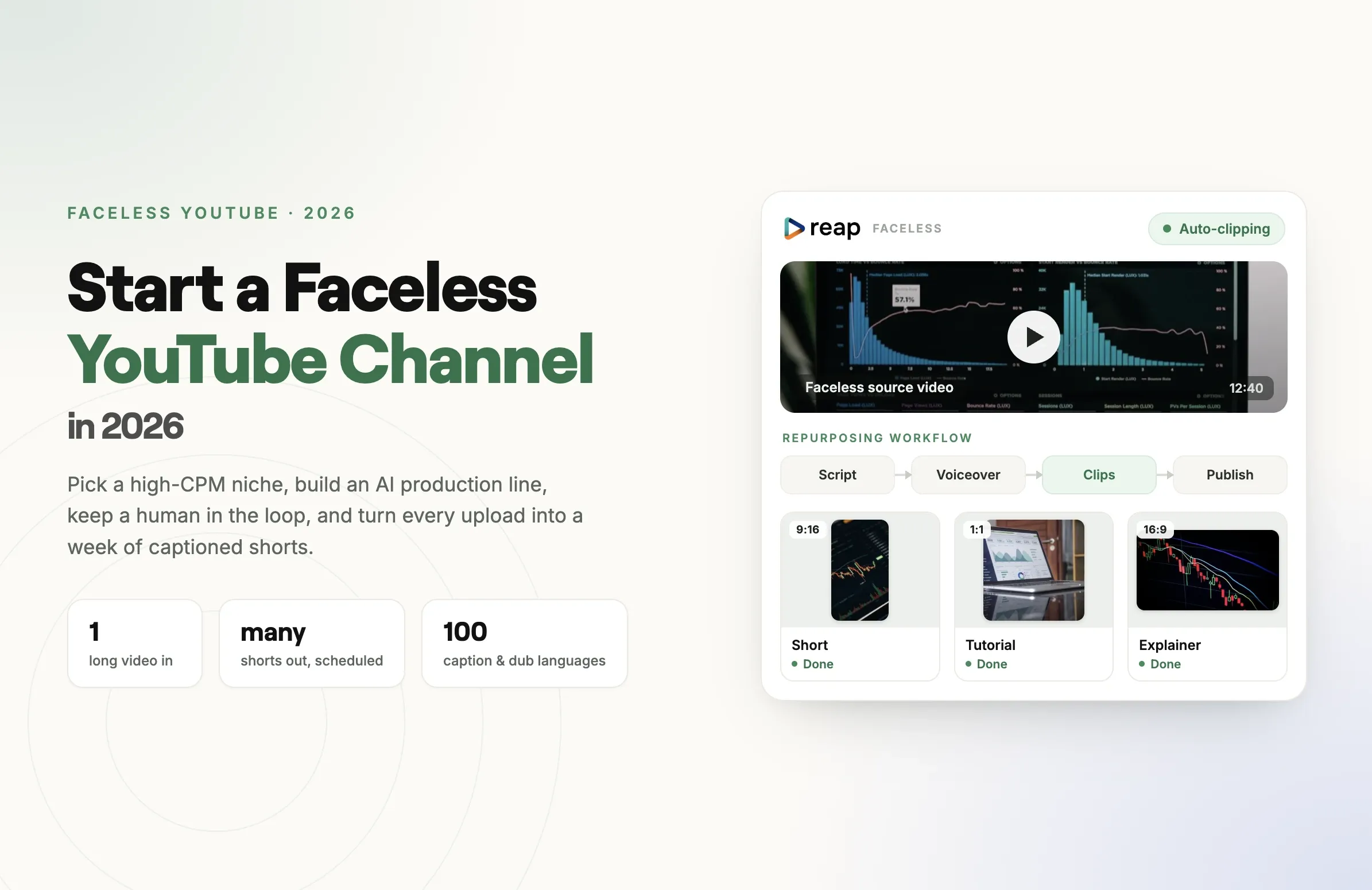
A faceless YouTube channel is one where you never appear on camera. You publish value through voiceover, stock or AI visuals, screen recordings, and captions instead of your face. To start one in 2026, pick a high-CPM niche, script genuinely useful videos, produce them with an AI voice and visuals, and repurpose each upload into shorts so one video becomes a week of content. The catch in 2026: YouTube now demonetizes mass-produced, low-effort AI content, so quality and human oversight are what keep you paid.
This guide covers the niches that actually pay, the exact tool stack, the step-by-step setup, and how to stay on the right side of YouTube's rules.
Already creating long-form? The fastest growth lever for any faceless channel is repurposing. See how to turn long videos into shorts on autopilot and automate YouTube Shorts creation.
What is a faceless YouTube channel?
A faceless YouTube channel is a channel that grows without the creator ever showing their face. Instead of a presenter on camera, the video carries its value through a voiceover (real or AI), visuals (stock footage, screen recordings, animation, or AI-generated clips), on-screen text, and captions.
You have seen these channels even if you did not realize it: finance explainers over stock charts, "top 10" list videos, history and true-crime narrations, meditation and sleep content, software tutorials, and motivational compilations. None of them depend on a personal brand or a camera setup.
The appeal is obvious. A faceless channel is location independent, does not require you to be comfortable on camera, can be produced from a laptop, and is far easier to systematize and eventually delegate or automate. It is the closest thing to a scalable content business that one person can start this weekend.
Do faceless YouTube channels still work in 2026?
Yes, but the rules changed, and a lot of people missed the memo. In July 2025 YouTube renamed its "repetitious content" policy to "inauthentic content," and in January 2026 it carried out the largest wave of AI-channel terminations in its history. The channels that got hit shared a pattern: synthetic voiceovers, templated scripts, zero human insight, and upload schedules built around volume instead of substance.
Here is the part that matters: YouTube did not ban AI, and it did not ban faceless channels. It demonetized low-effort, mass-produced content regardless of how it was made. AI-assisted research, scripting, voiceover, thumbnails, and editing are all still fine. What gets you terminated is publishing machine-made filler with no original point of view. We wrote about this shift in detail in the rise of AI slop video.
So the 2026 playbook is not "generate 30 videos a day and hope." It is "produce genuinely useful videos with a human in the loop, then maximize the reach of each one." That second half, getting more distribution out of every video you make, is where most faceless creators leave the biggest gains on the table.
Best faceless YouTube niches in 2026
Pick a niche where two things overlap: real search demand and high advertiser value (CPM). High-CPM niches pay several times more per thousand views than entertainment niches, so they are worth far more even at smaller scale.
| Niche | Why it works in 2026 | CPM tier |
|---|---|---|
| Personal finance & investing | Evergreen demand, advertisers pay top dollar, easy to do with charts and voiceover | Very high |
| Software, SaaS & AI tool tutorials | Screen recordings only, buyer intent, sponsor-friendly | High |
| Productivity & self-improvement | Broad audience, simple visuals, strong watch time | Medium-high |
| Business & side-hustle explainers | High CPM, repurposes into shorts well | High |
| History, true crime & documentary | Huge watch time, narration plus archival or AI visuals | Medium |
| Health, fitness & psychology | Evergreen, strong search, advertiser interest | Medium-high |
| Tech news & product breakdowns | Constant fresh topics, clip-friendly | Medium |
| Sleep, meditation & ambient | Long watch sessions, minimal scripting | Low CPMhigh volume |
The easiest niches to start are software tutorials, productivity, and tool comparisons, because they can be made from scripts, screenshots, stock footage, and an AI voiceover with no special skills. The highest-paying are finance, business, and software. Choose the overlap between what pays and what you can talk about credibly for 100 videos.
How to start a faceless YouTube channel in 7 steps
- Pick one niche and one format. Commit to a single niche and a repeatable format (for example, "7-minute personal finance explainers"). Consistency of format is what trains the algorithm and your production pipeline.
- Validate demand before you build. Search your topic ideas on YouTube and check whether videos from small channels are getting views. If only large channels rank, the niche is saturated; if small channels get traction, there is room.
- Write a genuinely useful script. Use an AI model to draft and structure, then add a real point of view, a specific example, or original analysis. This human layer is what keeps you monetizable. Hook in the first 10 seconds, deliver on the title, and avoid filler.
- Generate the voiceover. Use a high-quality AI voice (or your own narration) that is clear and emotive. A natural voice dramatically affects retention.
- Assemble the visuals. Pair the voiceover with screen recordings, stock footage, simple motion graphics, or AI-generated b-roll. Match visuals to what the narrator is saying so the viewer never drifts.
- Caption and brand every video. Add captions (a large share of viewing happens on mute), a consistent thumbnail style, and an intro/outro. Captions also make every clip you cut later instantly usable.
- Publish, then repurpose immediately. Upload the long-form video, then cut it into 5 to 15 vertical shorts for YouTube Shorts, TikTok, Reels, and LinkedIn. Each platform has its own limits, so check the LinkedIn video specs before you post there. This is the single highest-leverage step, and the one most beginners skip.
Step 7 is where one video becomes a week of content. It is also fully automatable, which we cover next.
The faceless YouTube AI tool stack
A modern faceless channel runs on five layers. You can start with free tiers and upgrade only where you hit a real bottleneck.
- Script & ideation: an AI writing model (ChatGPT, Claude, or Gemini) for outlines, research, and drafts. You supply the angle and the edits.
- Voiceover: an AI voice generator such as ElevenLabs for natural narration, or your own voice for maximum authenticity.
- Visuals: stock libraries, screen recorders, and AI video generators for b-roll, plus a thumbnail tool.
- Editing & captions: an editor that adds animated captions, reframes to vertical, and brands clips. See the best caption apps for YouTube videos.
- Repurposing & distribution: an AI clipping tool that turns each long video into many scheduled shorts. This is where Reap lives, and it is the layer that multiplies your output without multiplying your effort.
The mistake is overspending on tools before validating the channel. Do not pay for a $300/month stack until two or three months of real audience data tells you which layer is actually your constraint.
How to automate a faceless channel without making "AI slop"
Automation is not the enemy. Mindless automation is. The 2026 distinction is simple: automate the repetitive production and distribution work, keep a human on the creative judgment.
Safe to automate:
- Clipping and reframing: turning a long video into vertical shorts, with the speaker or focal point tracked automatically.
- Captioning, branding, and translation: applying your caption style, watermark, and subtitles across every clip in one pass.
- Scheduling and publishing: pushing finished clips to YouTube Shorts, TikTok, Reels, and LinkedIn on a calendar.
- Dubbing for global reach: turning one English video into many languages to multiply views from the same script.
Keep a human on: the niche angle, the script's original insight, the hook, and a final quality check before anything publishes. You can wire the production line together with no-code tools or an API, exactly the clip-to-publish workflow we break down here. For a deeper look at letting an AI agent run the repetitive steps, see what a clipping agent is.
The goal is leverage, not volume for its own sake. One thoughtful video, repurposed into 12 captioned shorts and dubbed into 5 languages, beats 12 thin AI videos that risk demonetization.
How to keep your faceless channel monetizable
To qualify for the YouTube Partner Program you still need 1,000 subscribers and either 4,000 valid public watch hours or 10 million Shorts views in the trailing period. Getting in is the easy part. Staying monetized in 2026 is about the "inauthentic content" rule.
Stay on the safe side by making sure every video has:
- Original value: a specific take, example, comparison, or analysis a viewer cannot get from a generic AI summary.
- Human oversight: you edit the script, fact-check claims, and approve the final cut. AI assists, it does not publish unattended.
- Production quality: clear audio, captions, visuals that match the narration, and thumbnails that are not templated spam.
- Sustainable cadence: consistent uploads built around quality, not a firehose of near-identical videos.
Repurposing helps here too. Cutting one strong long-form video into many shorts is not "mass-produced" content in YouTube's sense, because each clip comes from genuine, human-reviewed source material. It is the legitimate way to be everywhere at once.
How Reap turns one video into a week of content
The faceless channels that win in 2026 are not the ones making the most videos. They are the ones extracting the most distribution from each video they make. That is exactly what Reap is built for.
Feed Reap one long faceless video and it will:
- Find the strongest moments and cut them into vertical shorts that track the focal point automatically.
- Caption every clip in your style, with support for up to 100 caption languages and Romanized scripts.
- Dub the video into 80 languages so a single English upload can earn views from global audiences.
- Schedule and publish the clips across YouTube Shorts, TikTok, Reels, and LinkedIn, with throughput high enough for an agency-scale calendar.
- Run from an API, CLI, or MCP server, so you can wire it into an automated pipeline or drive it from an AI agent like Claude or ChatGPT.
That turns the highest-leverage, most tedious part of a faceless channel, distribution, into a background process, while you keep your human attention on the script and the niche. Start free at app.reap.video or see Reap pricing.
Common mistakes to avoid
- Chasing volume over value. The fastest way to get demonetized in 2026. One good video beats ten templated ones.
- Skipping repurposing. Publishing only long-form and ignoring shorts leaves most of your potential reach unused.
- Over-investing too early. Do not buy a $300/month tool stack before you have validated the niche with real views.
- No human in the loop. Fully unattended AI publishing is exactly what YouTube's inauthentic-content policy targets.
- Ignoring global audiences. If you are not dubbing or translating, you are leaving a multiple of your views on the table.
- Inconsistent format. Random topics and formats confuse both the algorithm and your production pipeline.
The bottom line
Starting a faceless YouTube channel in 2026 is still one of the best one-person content businesses you can build, but the winning formula flipped. It is no longer about generating the most videos. It is about producing genuinely useful videos with a human in the loop, then squeezing maximum distribution out of each one through clipping, captioning, dubbing, and scheduling.
Pick a high-CPM niche, build a simple AI-assisted production line, keep your judgment in the loop, and let a tool like Reap handle the repetitive repurposing. Try Reap free at app.reap.video and turn every faceless upload into a week of content.
.webp)