AI video is having two moments at the same time.
One is exciting. Creators can edit faster, generate captions, translate videos, reframe horizontal footage into vertical clips, remix ideas, and turn one strong recording into weeks of useful content.
The other is ugly. Feeds are filling with low-quality AI-generated videos that feel vaguely watchable for three seconds, then empty by the end. Fake stories. Synthetic explainers. Recycled scripts. AI voiceovers reading generic copy. Visuals that look impressive at first glance but collapse when the viewer asks, "Who made this, and why should I trust it?"
That second category has a name: AI slop.
AI slop is not just a meme anymore. YouTube CEO Neal Mohan used the phrase directly in his 2026 letter while discussing low-quality AI content, synthetic media, labels, and creator likeness protections. Search Engine Journal also reported on the scale of AI slop in YouTube Shorts, citing research that found a meaningful share of Shorts recommendations shown to new users were low-quality AI-generated videos.
At the same time, AI video tools are becoming more powerful and more mainstream. YouTube is adding AI creation and remix tools to Shorts. IAB projects U.S. digital video ad spend will surpass $80 billion in 2026, and says agentic and generative AI are moving from experimental to operational in digital video campaigns. Meltwater and YouGov found that consumers increasingly expect transparency around AI-generated content.
So the question for creators and brands is no longer, "Should we use AI in video?"
The better question is:
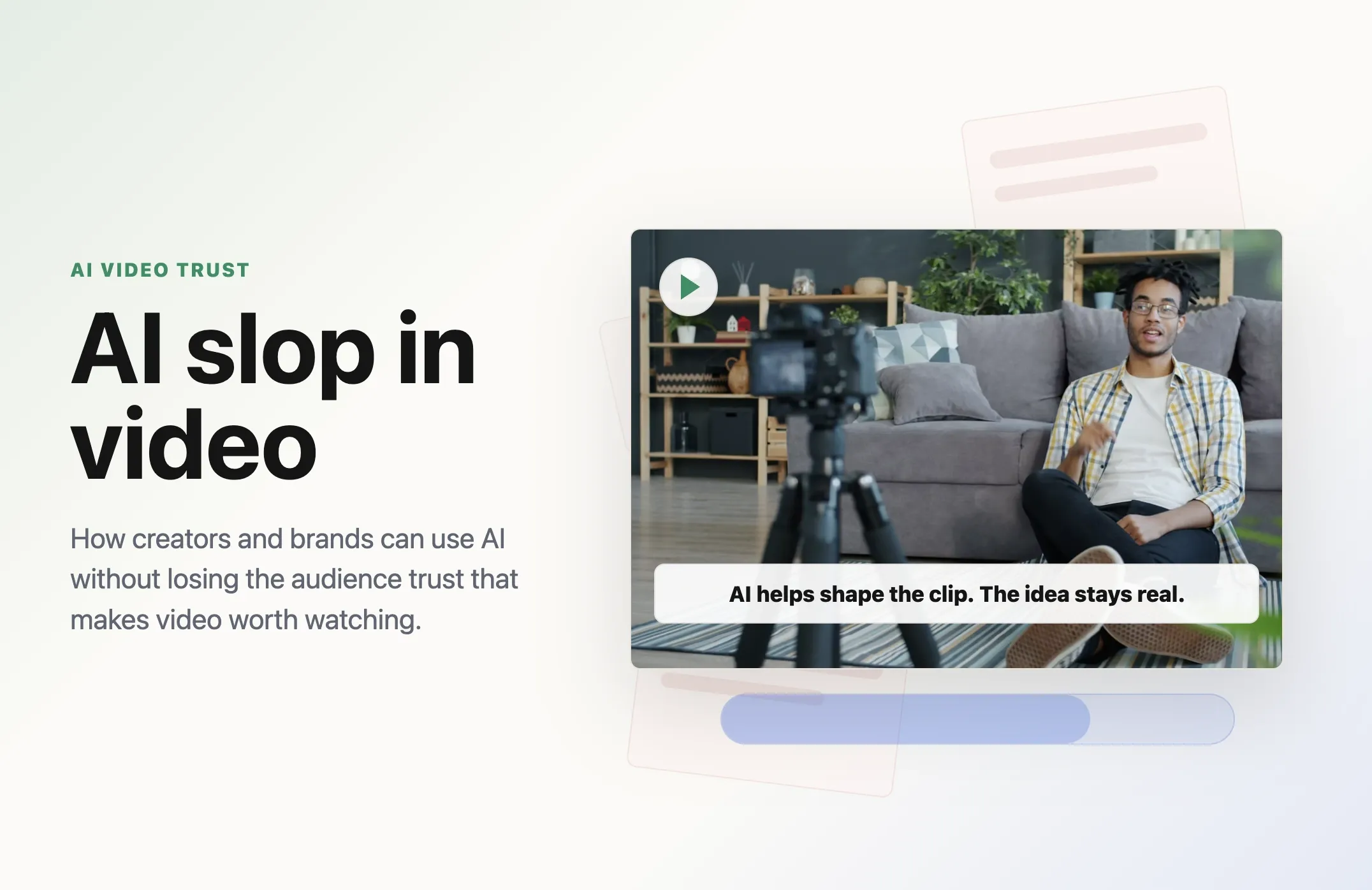
How do you use AI video tools without becoming part of the slop?
What is AI slop?
AI slop is low-quality, repetitive, mass-produced AI content that is optimized for output rather than value.
It is content that exists because it can be generated quickly, not because it needed to be made.
In text, AI slop often looks like generic articles, rewritten summaries, thin listicles, or pages that answer a search query without adding expertise.
In images, it can look like strange visual spam, fake product shots, synthetic lifestyle content, or uncanny social posts.
In video, AI slop is more powerful because it can combine several forms of automation at once:
- AI-generated visuals
- AI voiceovers
- AI scripts
- AI avatars
- Auto captions
- Auto editing
- Synthetic music
- Reused templates
- Mass publishing workflows
None of those elements are bad by themselves. Captions are useful. AI editing can save hours. Synthetic visuals can be creative. Automation can help small teams compete.
The problem starts when the full workflow is pointed at volume with no accountability.
That is when AI video stops feeling like a tool and starts feeling like noise.
What does AI slop look like in video?
AI slop video usually has a few recognizable patterns.
It may start with an exaggerated hook: "You will not believe what happened next," "Scientists are hiding this," or "This one trick changes everything."
The visuals may be synthetic, mismatched, or overly dramatic. The voiceover may sound fluent but empty. The script may repeat a familiar structure without adding evidence, context, or a real point of view.
Some AI slop is obvious. The faces look wrong. The hands are strange. The story makes no sense. The clips feel stitched together from unrelated prompts.
Other AI slop is harder to spot. It looks clean. It has captions. It uses a confident voice. It follows a familiar short-form rhythm. It may even get millions of views.
That is why AI slop matters. The issue is not only bad aesthetics. The issue is trust.
A viewer may watch one low-quality AI video and move on. But if a platform, channel, or brand repeatedly publishes content that feels synthetic, unverifiable, or hollow, the audience starts to assume the next video is also cheap.
Trust is hard to earn and easy to train away.
Why video is especially vulnerable to AI slop
AI slop spreads in video because video has always been expensive to make.
Before generative AI, a team had to write, record, edit, caption, export, and publish. Even a simple talking-head clip took time. That natural friction limited how much low-effort content could be produced.
AI removes much of that friction.
Now a bad actor, spam network, or low-effort content farm can generate scripts, voiceovers, avatars, images, clips, and captions in a pipeline. The result may not be excellent, but it may be good enough to win a few seconds of attention in a feed.
Short-form video is especially exposed because the format rewards speed and volume.
On a swipe-based feed, the first few seconds matter enormously. If a synthetic video can stop a viewer for a moment, it may get distribution even if the full clip has little value. That creates an incentive to produce more hooks, more formats, and more variations.
Long-form video has more built-in resistance. A viewer choosing a 15-minute video usually evaluates the title, thumbnail, channel, topic, comments, and perceived authority. Short-form video gives viewers less time to make that judgment.
This does not mean Shorts, Reels, and TikToks are bad. It means quality signals matter more than ever.
Why AI slop is becoming a brand problem
For individual viewers, AI slop is annoying.
For platforms, it is a quality problem.
For brands, it is a trust problem.
Brands are under pressure to create more video than ever. Social teams need Shorts, Reels, TikToks, LinkedIn clips, YouTube videos, ads, product explainers, customer stories, webinars, demos, and localized content. Video ad spend keeps growing, and audiences expect brands to show up with content that feels native to each platform.
AI looks like the obvious answer.
But if a brand uses AI only to increase output, it can accidentally flatten its own voice. The videos may become more frequent but less distinctive. The captions may be accurate but generic. The clips may be polished but forgettable. The scripts may be optimized but unconvincing.
That is the danger.
AI slop is not only content that looks bad. It is content that makes the audience feel like nobody cared.
For brands, that feeling is costly.
Consumers are asking for transparency
The trust issue is not imaginary.
Meltwater and YouGov's 2026 research on consumer perception of generative AI found that consumers want brands to be more transparent and intentional about AI-generated content. The study reported that 86% of consumers say AI-generated content should be disclosed, and 73% are concerned about misinformation.
That does not mean every use of AI needs a warning label in the caption. Using AI to clean up audio, generate subtitles, translate a clip, or find strong moments in a webinar is different from creating a realistic synthetic person saying something they never said.
But it does mean audiences are becoming more sensitive to the line between assistance and deception.
The more realistic AI video becomes, the more important that line becomes.
Brands that use AI clearly and responsibly can earn trust. Brands that hide behind synthetic content may lose it.
The difference between AI-assisted video and AI slop
The useful distinction is not "AI video" versus "human video."
Most modern video workflows already use AI somewhere. Auto captions, background removal, transcription, translation, smart cropping, noise reduction, and edit suggestions are all forms of AI assistance. The best AI video editing tools make those tasks faster without removing the creator's judgment from the final video.
The real distinction is AI-assisted video versus AI slop.
AI-assisted video starts with a real reason to exist.
It may come from a podcast, webinar, interview, course, product demo, livestream, customer story, founder recording, or expert explanation. AI helps with the workflow: finding moments, cutting clips, adding captions, reframing, translating, editing, organizing, and publishing.
AI slop starts with the machine.
The goal is output. The source material is thin or synthetic. The hook is stronger than the substance. The workflow prioritizes quantity over judgment.
Here is the practical difference:
AI-assisted video vs AI slop video
| AI-assisted video | AI slop video |
|---|---|
| Starts from real expertise, footage, or ideas | Starts from a prompt or template with little source material |
| Uses AI to speed up production | Uses AI to replace the point of production |
| Keeps a human in review | Publishes at scale with minimal review |
| Adds captions, edits, translations, and formats | Generates low-effort videos for volume |
| Builds trust over time | Burns trust for short-term attention |
| Has a clear audience and purpose | Chases algorithmic reach without accountability |
This is where Reap fits naturally.
Reap is not about generating disposable videos from nothing. It helps creators, marketers, agencies, and teams take real source content and turn it into polished, publish-ready video assets through an AI video editor built for real content workflows.
That source content can be a podcast, webinar, interview, YouTube video, course, demo, or founder recording. Reap can help identify moments, create clips, add captions, reframe for vertical formats, edit the output, localize content, and move clips toward publishing. For teams already repurposing long-form content, this is the responsible version of AI video repurposing: use AI to unlock real ideas, not manufacture empty ones.
That is a responsible use of AI: less repetitive editing, more useful distribution, and more human judgment where it matters.
Why "more video" is not enough anymore
For years, the basic advice was simple: publish more.
More Shorts. More Reels. More TikToks. More clips from the podcast. More founder videos. More product explainers.
That advice is incomplete now.
When everyone can publish more, more is no longer a strategy.
The winning teams will not be the ones that generate the highest number of videos. They will be the ones that create the highest number of useful, trusted, on-brand videos without burning out their team.
That requires a different workflow.
Instead of asking, "How can we create 100 AI videos this month?" ask:
- What real expertise do we already have?
- What long-form content is underused?
- Which moments would help our audience?
- Which clips can stand alone?
- Which topics deserve human review?
- Which videos need disclosure or extra context?
- Which formats help the viewer take action?
- Which clips represent the brand well?
AI should make those answers easier to act on. It should not replace the questions.
A responsible AI video workflow for brands
The best way to avoid AI slop is to design the workflow before you scale the output.
Here is a practical model.
1. Start with real source material
The safest way to use AI video is to begin with content that already contains real value.
Good source material includes:
- Podcasts
- Webinars
- Founder interviews
- Customer interviews
- Product demos
- Livestreams
- Sales calls approved for marketing use
- Tutorials
- Courses
- Conference talks
- YouTube videos
- Internal training sessions
This gives the AI something real to work with.
Instead of generating a generic video about "five marketing tips," you can turn a real conversation with a founder, customer, expert, or operator into short clips that carry lived experience.
That is much harder for AI slop channels to replicate.
2. Use AI to find the strongest moments
Long videos often hide the best ideas.
A 60-minute webinar may contain three strong clips. A 45-minute podcast may have a powerful story at minute 31. A product demo may include one explanation that would make a perfect LinkedIn clip.
AI can help surface those moments faster.
This is one of the most useful roles for an AI video clipping tool. It does not decide your brand strategy. It reduces the manual work of scrubbing through every recording.
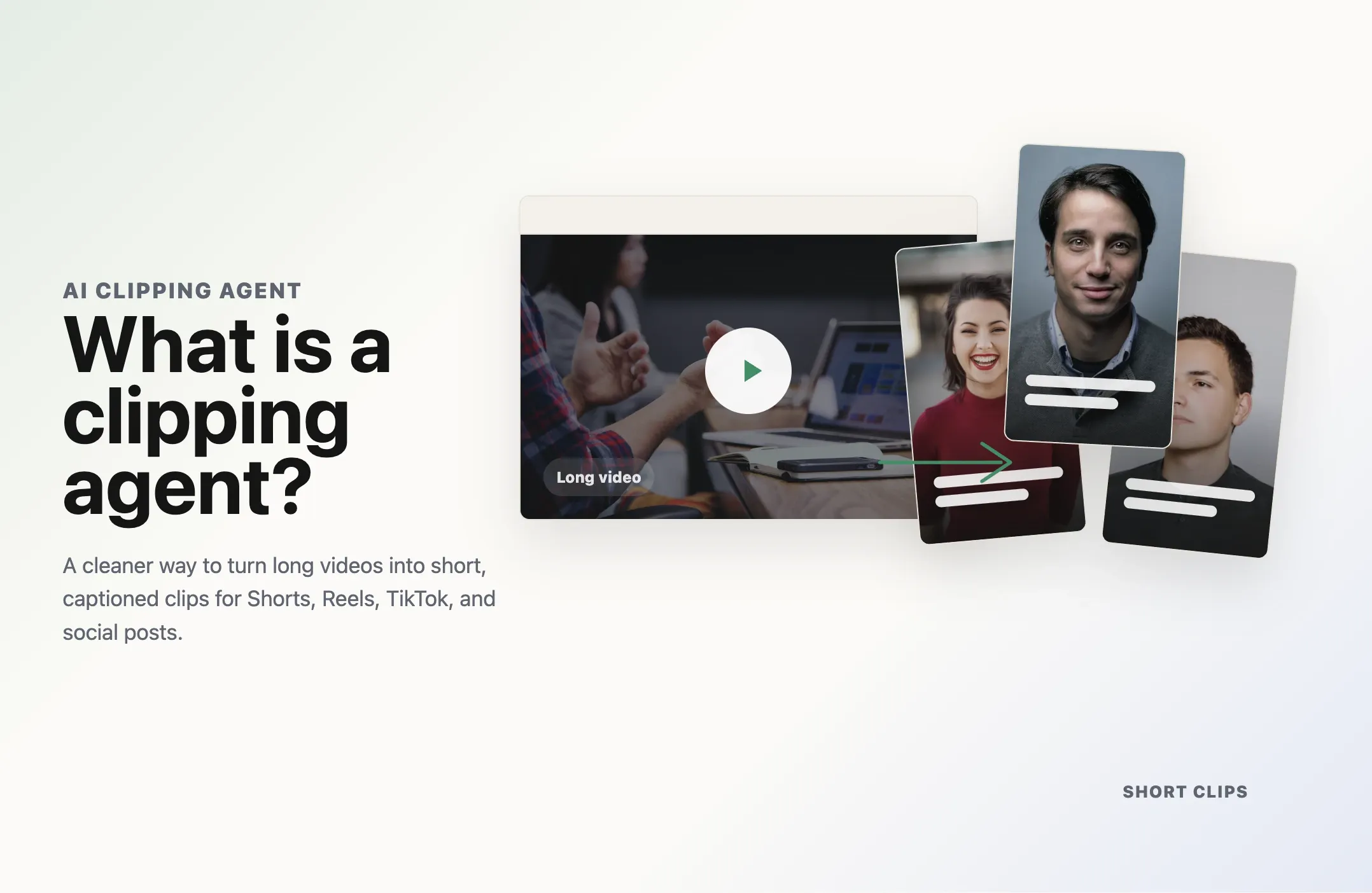
With Reap, teams can turn long-form videos into clips, then review and refine the best ones. That keeps the speed benefit of AI while preserving human judgment. If you want the workflow to feel more automated, a clipping agent can help move from long recording to review-ready clips without turning the channel into a content farm.
3. Keep humans in the review loop
AI can find moments. It cannot always know what your brand should say.
Before publishing, a human should check:
- Is this clip accurate?
- Does it preserve the original context?
- Does it make a complete point?
- Does the caption text match the audio?
- Does the video make any claim that needs proof?
- Is the framing flattering and clear?
- Does the clip feel useful or just attention-seeking?
- Would we be comfortable if this became a viewer's first impression of the brand?
That last question is a good filter.
AI slop often fails because nobody asks it.
4. Make captions useful, not just decorative
Captions are one of the most visible signs of quality in short-form video.
Bad captions make a clip feel cheap. They cover faces, hide important visuals, break awkwardly, miss words, or use loud styling that does not match the brand.
Good captions improve comprehension and retention. They help viewers watch without sound. They make clips more accessible. They can also support localization when paired with translation or dubbing.
Reap helps teams add styled captions and keep videos formatted for short-form platforms. That matters because trust is not only about facts. It is also about polish, clarity, and respect for the viewer's attention. Teams that need more control can use Reap's AI video editor to review, adjust, and polish the final clip before it goes live.
5. Reframe for the platform
A horizontal webinar clip dropped into a vertical feed without care feels lazy.
Short-form platforms have their own viewing context. Faces, captions, product screens, slides, and visual details need to fit inside the frame. Important text should not sit under platform UI. Speakers should not be cropped awkwardly.
AI reframing helps, but the final result still needs review.
The goal is not just to make the video vertical. The goal is to make the video feel native.
6. Add context when AI is part of the content
There is a difference between using AI behind the scenes and presenting AI-generated content as reality.
If AI is used for editing, captions, clipping, or formatting, the audience may not need a dramatic disclosure every time.
If AI is used to create realistic synthetic people, voices, events, testimonials, news-like scenes, or altered footage, transparency becomes much more important.
YouTube requires creators to disclose realistic altered or synthetic content, and platforms are investing in labels and protections because the line between real and synthetic is getting harder to see.
For brands, the safest rule is simple:
If the viewer could reasonably mistake synthetic content for a real person, real event, real endorsement, or real evidence, disclose it clearly.
7. Publish less junk, more signal
AI makes it easy to produce more than your audience wants.
Do not turn every long video into 40 clips just because you can.
Create a quality threshold:
- Strong hook
- Clear context
- Useful payoff
- Accurate captions
- Clean edit
- Brand-safe framing
- Platform-native format
- Human approval
If a clip does not meet the threshold, do not publish it.
That restraint is part of the brand.
Where Reap fits in an AI video trust workflow
Reap is useful because it helps teams use AI around content that already has substance.
Instead of starting with "generate a random video," Reap starts from real video inputs:
- A podcast episode
- A webinar recording
- A YouTube URL
- A founder interview
- A customer conversation
- A product demo
- A course or tutorial
From there, Reap can help teams create short-form clips, add captions, reframe for vertical formats, edit outputs, translate or dub content, and prepare assets for publishing. For technical teams, Reap's video MCP automation can also connect these steps into repeatable AI-assisted video workflows.
That workflow matters because the future of AI video editing is not only prompt-to-video generation. For many creators and teams, the bigger opportunity is source-to-distribution:
One real recording becomes multiple useful clips.
One expert conversation becomes social content.
One webinar becomes a campaign.
One product demo becomes a library of explainers.
One customer story becomes short-form proof.
AI helps with speed. The source content protects trust.
Brand trust checklist
AI slop examples brands should avoid
AI can help teams create video faster, but weak source material, fake urgency, and generic automation still feel cheap. These are the patterns that make brand video feel like AI slop, and the better choices that protect trust.
-
Generic advice with no proof
AvoidA video that says "Use AI to 10x your marketing" without showing data, examples, workflow, or experience is easy to ignore.
BetterUse clips from a real operator explaining what changed, what failed, and what they would do differently.
-
Fake urgency
AvoidHooks like "This platform is dying" or "Nobody is talking about this" may get attention, but they train viewers to distrust the channel.
BetterLead with a specific tension, trend, or problem the viewer recognizes.
-
Synthetic authority
AvoidAI avatars, stock-like footage, and generic voiceovers can make a brand sound bigger while making it feel less real.
BetterUse real team members, customer voices, product screens, founder commentary, or expert clips whenever possible.
-
Contextless clips
AvoidShort clips that start mid-thought or make a claim without setup can feel automated.
BetterTrim clips around complete ideas. A strong clip should have a beginning, a point, and a payoff.
-
Overproduction without substance
AvoidAnimated captions, emojis, sound effects, and fast cuts cannot save a weak idea.
BetterUse editing to clarify the message, not to hide the lack of one.
The filter is simple: if AI makes the video clearer, more useful, or easier to understand, it is helping. If it only adds noise around a weak idea, it starts to feel like slop.
How creators can compete with AI slop
Creators do not need to beat AI slop at volume.
They need to beat it at trust.
That means leaning into the parts of video that are hardest to fake:
- On-camera presence
- Real stories
- Personal experience
- Taste
- Specific examples
- Community interaction
- Behind-the-scenes context
- Long-form depth
- Consistent point of view
AI can support that work.
A creator can record one strong podcast, use Reap to find the best moments, turn those moments into captioned Shorts and Reels, review the clips, and publish consistently. That is the same principle behind the best AI clipping tools: reduce repetitive production work while keeping the creator's point of view intact.
That is not slop. That is leverage.
The creator is still the source of the ideas. AI makes the distribution workflow faster.
How brands can compete with AI slop
Brands have a different advantage: access.
They have product knowledge, customer conversations, internal experts, data, product screens, founders, support insights, webinars, demos, and real use cases.
Most of that material is underused.
The mistake is trying to compete with AI slop by generating generic videos about broad topics.
The better approach is to turn owned expertise into visible content, using a clear AI video repurposing workflow instead of asking AI to invent generic content from scratch:
- Clip product demos into problem-specific explainers.
- Turn webinars into short educational sequences.
- Repurpose founder interviews into point-of-view clips.
- Turn customer stories into proof-driven short videos.
- Use tutorials to answer high-intent search questions.
- Localize the best clips for new markets.
- Use captions and reframing to make every clip easier to watch.
This is where AI helps without weakening trust.
The brand is not pretending. It is making real knowledge easier to consume.
The future of AI video is not fully synthetic
Prompt-to-video tools will keep improving.
Some use cases will be genuinely creative. Concept videos, mood boards, ads, storyboards, visual experiments, entertainment formats, and impossible scenes will benefit from synthetic video.
But for brands and serious creators, fully synthetic video is only one part of the future.
The bigger opportunity is AI-assisted production:
- Faster clipping
- Better captions
- Smarter reframing
- Translation and dubbing
- Automated publishing workflows
- Content libraries
- Repurposing systems
- Agentic video operations
That is why the AI slop conversation matters.
It forces teams to choose what kind of AI video operation they want to build.
One path produces more noise.
The other path turns real expertise into more useful video.
A simple checklist before publishing AI-assisted video
Before publishing an AI-assisted video, ask:
- Is this based on real source content?
- Does the clip make a complete point?
- Is the claim accurate?
- Would a human expert stand behind it?
- Are captions correct?
- Is the framing clean?
- Does the viewer know what is real and what is synthetic?
- Does this help the audience, or does it only chase attention?
- Is the video worth associating with the brand?
If the answer is yes, AI is probably helping.
If the answer is no, the video may be drifting into slop.
AI video should make brands more useful, not less human
AI slop is what happens when video production becomes detached from intent.
The tools get faster. The templates get easier. The feeds get fuller. But the content gets thinner.
That is not inevitable.
AI can also help creators and brands become more useful. It can make strong ideas easier to find, clip, caption, translate, reframe, and publish. It can help small teams act like larger media teams. It can help experts show up more consistently without spending every week buried in editing timelines, especially when the workflow is built around a real AI video clipping tool instead of synthetic filler.
The difference is the workflow.
Start with real content. Use AI to reduce production drag. Keep humans in review. Be transparent when synthetic content could mislead. Publish for trust, not just volume.
That is how brands can use AI video without becoming AI slop.
And that is the lane Reap is built for: helping teams turn real videos into polished, captioned, platform-ready content faster, while keeping the human judgment that makes the content worth watching. Start with Reap's AI video clipping tool, use the AI video editor for review and polish, or explore video MCP automation if you want agentic workflows around real source content.
Use Reap to scale video without losing the human judgment that makes your content worth watching.