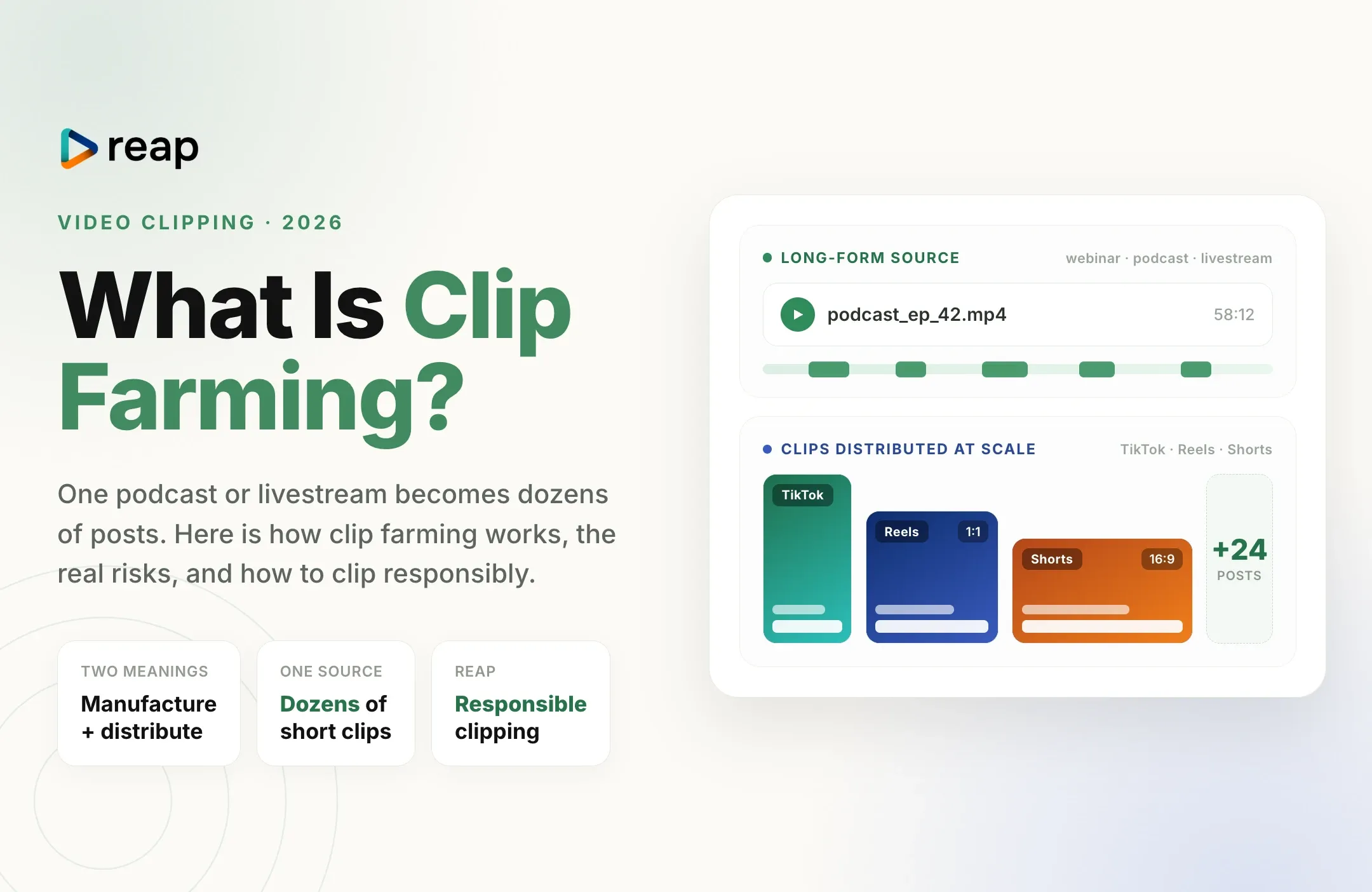
Clip farming is the practice of intentionally creating or distributing many short video clips to maximize reach, views, traffic, or conversions. It can describe streamers manufacturing dramatic moments designed to become viral clips, or brands and creators paying networks of clippers to extract and publish short videos from longer content.
One podcast, livestream, interview, webinar, or campaign can become dozens of posts across TikTok, Instagram Reels, YouTube Shorts, X, and other feeds. That creates more opportunities for discovery without recording every video from scratch.
It also creates questions about copyright, advertising disclosure, misleading edits, originality, brand safety, and whether large view counts produce meaningful business results.
This guide explains both meanings of clip farming, how the model works, why it is attracting brands in 2026, and how to build a responsible clipping workflow without turning useful content into spam.
Why “clip farming” has two meanings
“Clip farming” is still an emerging term, and people use it in two distinct but related ways.
1. Manufacturing moments designed to go viral
In streaming and creator communities, clip farming can mean deliberately saying or doing something exaggerated, dramatic, funny, or shocking because it is likely to be clipped and shared.
The Cambridge Dictionary blog highlighted this meaning in February 2026. Restream uses a similar definition in its guide to clip farming in livestreaming.
This version begins before editing. The creator structures the original content around moments that can travel independently.
2. Distributing clips at scale
In marketing and the creator economy, clip farming increasingly describes a scaled distribution system. A brand, creator, artist, media company, or public figure supplies source content, and many clippers or accounts turn it into short posts.
Those clips may be published by an official social team, an agency, freelancers, fans, affiliates, or anonymous theme accounts. Some campaigns pay for approved clips; others use retainers, affiliate rewards, contests, or payments tied to views.
Both meanings share the same idea: content is created or distributed around the probability that a short moment will spread.
This article covers both meanings but focuses mainly on the brand and distribution model.
How does clip farming work?
A coordinated campaign usually follows this process:
- Choose source material: a podcast, livestream, interview, launch, event, webinar, music video, product demo, or other approved footage.
- Set the objective: awareness, entertainment, traffic, product discovery, app installs, subscriptions, or interest in the full content.
- Define the rules: usage rights, platforms, approved claims, required context, attribution, disclosure, and prohibited edits.
- Assign clippers: employees, freelancers, agencies, affiliates, or a performance-based network.
- Create variations: select moments, adjust boundaries, add captions and hooks, reframe, and format for each platform.
- Publish: use official channels, creator accounts, or a distributed network.
- Measure: track views, completion, engagement, clicks, subscriptions, conversions, or other campaign outcomes.
- Iterate: create more variations from the moments and messages that performed well.
Source content → campaign brief → clippers → clip variations → distribution → measurement → iteration
The attraction is simple: one source creates many experiments. The weakness is that quality and control become harder as the number of clippers and accounts increases.
Why clip farming is growing in 2026
Long-form content and short-form discovery now serve different jobs.
Podcasts, webinars, livestreams, interviews, courses, and events create depth. Short clips create more entry points. A viewer may never search for a 90-minute episode but may stop for a 35-second story, demonstration, argument, or joke from it.
In June 2026, The Wall Street Journal reported that brands, investors, and creator-led companies were putting more money behind clipping. The report described campaigns in which longer videos are cut into short posts and distributed for reach, sometimes through anonymous creators.
The model appeals to marketers because:
- Brands already own valuable footage that is underused.
- Every new clip creates another opportunity to enter a recommended feed.
- Performance-based payouts can shift some distribution risk to clippers.
- One source can support multiple audiences, messages, and campaign stages.
- AI reduces the work required to find moments, add captions, and format clips.
- Clip results can reveal which messages deserve more investment.
But more output is not the same as more value. The campaign still needs useful source material, an honest edit, and a path from attention to the desired outcome.
Current examples of clip farming
The clipping economy includes several different models.
Brands repurposing their own campaigns
The Wall Street Journal reported that DoorDash mined its own Super Bowl campaign and sponsored podcast material for short clips posted through its official account. This is closer to controlled repurposing than anonymous clip farming, but it shows why brands are interested: expensive source content can keep producing distribution.
Marketplaces connecting campaigns with clippers
Clipping marketplaces connect campaigns with people who create or publish short clips. These systems can standardize payments and campaign rules, but viewers may not always know whether a post is organic or incentivized.
Creators funding large clipping networks
Business Insider reported that livestreamer N3on spent more than $1.4 million over roughly five weeks on a large clipping network. The example shows how quickly the model can scale, but also why performance incentives need safeguards. See Business Insider's report.
An official brand account repurposing approved footage is very different from hundreds of accounts competing for payouts. Both use clipping, but their disclosure, control, and reputation risks are not the same.
Comparison
Clip farming vs video clipping
The difference is scale, intent, and how much editorial control remains.
| Term | What it means | Example | Main risk |
|---|---|---|---|
|
Video clipping
|
Extracting useful moments from a longer video | Turning a webinar into three product clips | Weak selection or missing context |
|
Content repurposing
|
Adapting content into other formats | Turning a podcast into clips, articles, and emails | Repetition without platform fit |
|
AI video clipping
|
Software helps find, cut, caption, and reframe moments | Generating first-draft Shorts from an interview | Publishing drafts without review |
|
Manufactured clip farming
|
Creating moments deliberately designed to spread | A streamer staging an exaggerated reaction | Trust and reputation damage |
|
Distributed clip farming
|
Many accounts publish clips at scale | A campaign rewarding clippers by performance | Disclosure, rights, spam, and control |
|
Responsible clipping
|
Approved footage, clear goals, review, and attribution | A webinar becoming purpose-built campaign assets | Requires editorial standards |
A team does not need a clip farm to benefit from short-form video. Three strong clips with clear jobs can be more valuable than 100 weak variations.
How do clip farmers get paid?
Common compensation models include:
- Fixed fee per approved clip
- Monthly retainer
- Payment according to views or another performance metric
- Affiliate commission tied to signups or sales
- Contest or campaign prize pool
Performance-based payment can generate high output, but it may also reward sensational hooks, weak context, reposting, or low-quality volume.
The payment model should therefore sit inside a wider set of rules covering source rights, accounts, claims, disclosures, originality, approval, and removal.
Why brands and creators use clip farming
When managed carefully, clipping can provide legitimate benefits.
More distribution from existing content
A long podcast, event, interview, or demo usually contains more useful material than one upload can expose. Clipping gives individual ideas a chance to reach people who would not watch the full source.
Faster message testing
Different clips can test hooks, benefits, stories, objections, and audiences. Results can reveal which parts of the original content deserve more attention.
Lower production burden
Repurposing approved footage can be more efficient than recording a separate video for every post. AI-assisted video summarization can also help teams locate relevant moments.
A path back to long-form content
A useful clip can act as a trailer for the full episode, livestream, webinar, or campaign—provided the clip includes clear attribution and a next step.
Seven risks of clip farming
1. Undisclosed commercial relationships
A paid clip can look like an independent recommendation when the relationship is hidden.
The US Federal Trade Commission says a material connection—including payment or free products—should be obvious when someone endorses a brand. Its Disclosures 101 guidance is directly relevant to paid clipping campaigns.
Disclosure should be part of the campaign brief, contract, publishing checklist, and monitoring process.
2. Copyright and licensing problems
Publicly accessible footage is not automatically free to download, edit, or republish.
A source video may contain separate rights in the recording, music, graphics, event footage, guest appearances, or third-party clips. A brand may own the interview but not the music used in it.
Rights should be confirmed before distribution begins.
3. Loss of context
The start, end, crop, headline, and captions all affect meaning. Removing one qualification can turn a careful statement into an absolute claim.
Before approval, ask whether the clip preserves the speaker's meaning, contains necessary context, and accurately describes the source.
4. Misleading hooks and claims
Performance incentives can encourage clippers to make a clip sound stronger than it is.
This is especially risky in finance, healthcare, education, SaaS, and other categories where a dramatic caption can become a misleading product or outcome claim.
5. Reused-content and monetization problems
Permission to post footage does not guarantee monetization.
YouTube's policies include reviews for reused and repetitive content. It allows transformed material when viewers can see meaningful original value, but channels built mainly from minimally changed footage may be ineligible. Review YouTube's monetization policies.
Copyright, platform permission, and monetization eligibility are separate questions.
6. Spam and audience fatigue
Flooding feeds with similar footage, captions, and hooks can make a campaign feel artificial. Different clips should have different editorial purposes, not merely different timestamps.
7. Weak business outcomes
A controversial clip may generate large reach while attracting the wrong audience. An anonymous account may earn views but send little traffic to the original creator.
Define success before publishing begins.
Is clip farming legal?
Clip farming is not inherently unlawful, but individual campaigns can create legal and contractual risk.
Important questions include:
- Who owns the footage?
- Does the campaign have permission to edit and redistribute it?
- Are music and third-party elements licensed?
- Does the clip contain a paid endorsement?
- Is disclosure required in the target country?
- Does the clip make a claim that requires evidence?
- Are people shown in the footage covered by appropriate agreements?
- Do the accounts comply with platform rules?
Giving credit does not replace permission. Adding captions, cropping a video, or using only a few seconds does not automatically create fair use.
This article provides general information, not legal advice. High-risk campaigns should be reviewed by qualified counsel.
Disclosure and platform rules
FTC
The FTC says material relationships should be clear and conspicuous. It also states that both the marketer and the endorser have responsibilities. Brands should train participants, provide instructions, and monitor the posts created on their behalf.
TikTok
TikTok requires users promoting a brand, product, or service to use its content-disclosure setting. Content posted for another business can receive a Paid partnership label. TikTok says using the setting does not itself reduce distribution. See TikTok's commercial-content guidance.
YouTube and other platforms
YouTube provides paid-promotion tools, but disclosure does not solve rights or monetization issues. Instagram, X, LinkedIn, and regional regulators can apply additional requirements.
International campaigns should not assume that one label or disclosure format works everywhere.
How to run a responsible clipping campaign
Step 1: Use approved source content
Start with footage the campaign has the right to edit and distribute, such as owned podcasts, webinars, demos, interviews, courses, livestreams, events, or original YouTube videos.
Step 2: Give every clip a job
Do not begin with “make as many clips as possible.”
| Clip type | Purpose | What to select |
|---|---|---|
| Trailer | Build curiosity | Tension, reveal, emotional peak |
| Product promo | Explain value | Problem, workflow, outcome |
| Educational clip | Teach one idea | Clear explanation, practical advice |
| Customer proof | Build trust | Specific pain, change, result |
| Objection clip | Support sales | Honest answer, reassurance, evidence |
| Founder POV | Build authority | Distinct perspective, category insight |
Purpose changes what counts as the best moment.
Step 3: Create a campaign brief
Define the source, audience, platforms, approved messages, prohibited claims, attribution, disclosure, editing rules, payment model, approval process, and takedown process.
Step 4: Use AI to create options
An AI video clipping tool can accelerate transcription, selection, clip creation, captions, and reframing.
Use prompt clipping when you need a specific asset rather than generic highlights.
For example:
Create three customer-proof clips. Each should include the customer's problem, the change they experienced, and a specific result. Exclude general compliments without evidence.
AI should return candidates for review, not remove accountability.
Step 5: Review before publishing
Check clip boundaries, context, names, statistics, claims, captions, framing, disclosure, attribution, and platform fit. Sensitive categories need stricter approval.
Step 6: Create meaningful variations
Do not publish near-identical copies. The same source can become an educational Short, a founder insight for LinkedIn, a product demo for a landing page, a customer quote for sales, or a trailer for the full episode.
Step 7: Automate only after guardrails exist
Teams can automate video clipping for recurring approved sources, and a clipping agent can coordinate production.
Keep human approval for regulated claims, paid promotion, sensitive people, and reputation-sensitive clips.
Step 8: Monitor live posts
Create a process for correcting captions, removing misleading edits, updating disclosure, handling rights complaints, and pausing participants who ignore campaign rules.
How Reap supports responsible video clipping
Reap helps brands, creators, agencies, and media teams turn approved long-form footage into review-ready clips.
A practical workflow is:
- Upload approved footage or paste a supported link.
- Generate clips automatically or describe the intended asset.
- Review the candidate moments and adjust the boundaries.
- Correct captions, names, and claims.
- Reframe for vertical, square, or landscape output.
- Apply approved branding.
- Export or prepare the final assets for publishing.
Reap can reduce the repetitive work of finding, cutting, captioning, and formatting clips. The user remains responsible for rights, disclosure, editorial accuracy, brand safety, and final approval.
Teams comparing platforms can review the top AI clipping tools in 2026.
Metrics that matter beyond views
Match measurement to the clip's purpose.
| Goal | Useful metrics |
|---|---|
| Awareness | Unique reach, completion rate, shares, profile visits, branded search |
| Long-form discovery | Clicks to source, full-video starts, watch time, subscriptions |
| Education and authority | Saves, meaningful comments, quote shares, backlinks, sales-team reuse |
| Product and sales | Qualified visits, trial starts, demo requests, assisted conversions |
| Trust and risk | Sentiment, disclosure compliance, takedowns, rights complaints, corrections |
A clip with fewer views can be more valuable when it reaches the right audience and produces the right next action.
Is clip farming worth it?
Clip farming can be worth testing when the brand owns strong source material, the campaign has clear rights and disclosures, clips have defined purposes, the team can review distributed posts, and performance is measured beyond views.
It is a poor fit when rights are unclear, the campaign depends on misleading hooks, the category is highly regulated without strong approval, or the only objective is to flood feeds.
For many brands, the better starting point is a controlled internal clipping program: turn each approved long-form asset into a small set of high-quality, purpose-built clips before considering a large external network.
The future of clip farming
The behavior will continue even if the phrase changes.
Creators will keep designing moments that travel beyond the original broadcast. Brands will keep repurposing expensive long-form production. Marketplaces will keep connecting campaigns with editors and publishers. AI will keep reducing production time.
The durable version will look less like anonymous volume and more like governed distribution: approved source libraries, verified clippers, transparent incentives, visible disclosures, rights tracking, human review, platform-specific creative, and measurement tied to business outcomes.
Final thoughts
Clip farming can describe a creator manufacturing moments for virality, a brand repurposing its own campaign, or a paid network distributing clips through many accounts. Those models have different levels of control and risk.
The useful idea underneath the trend is straightforward: long-form content often contains more distributable value than one upload can expose.
The responsible approach is to use approved source material, give every clip a purpose, preserve context, disclose incentives, review the output, and measure whether the attention contributes to a real goal.
That is how brands and creators can gain the distribution benefits of clipping without sacrificing the trust that makes attention valuable.